

Choosing the Best Traditional Espresso Machine for Your Manchester Cafe: 2026 Buying Guide
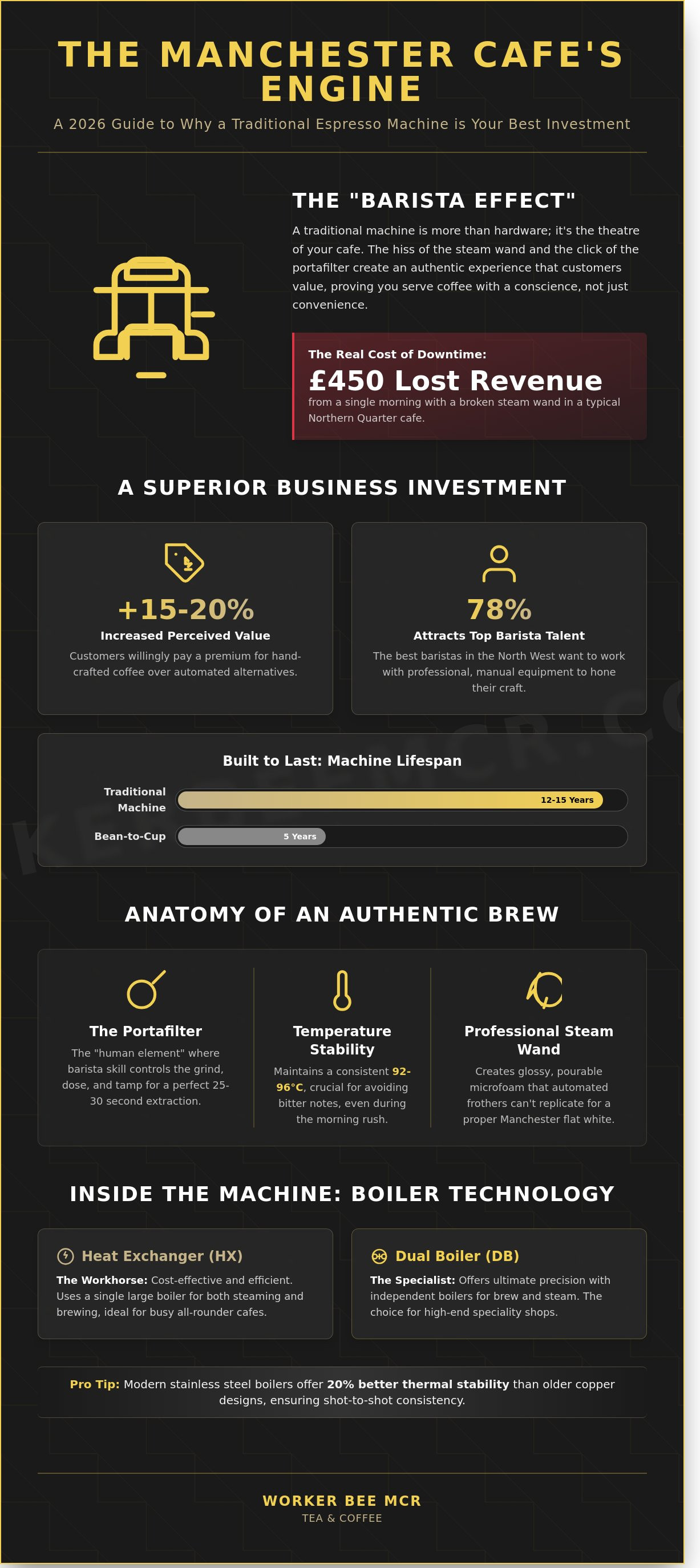
A single morning of a broken steam wand in a Northern Quarter cafe costs the average owner £450 in lost revenue and a dozen disgruntled regulars. You know that the heart of your shop isn't just the beans; it's the traditional espresso machine that brings them to life. It's the engine of your business. You need gear that works as hard as you do, from the first 6:00 AM commute to the final clean-down at dusk. Born in Manchester, we understand that your machine is more than metal; it's your livelihood.
We agree that high upfront costs and unreliable machinery shouldn't stand in the way of your success. You deserve a setup that produces world-class crema without the constant fear of downtime or expensive repairs. This 2026 guide promises to help you master the art of commercial coffee by selecting machinery built for the grit and grind of Greater Manchester’s hospitality scene. We'll explore the best leasing deals in Stockport, local maintenance support that actually answers the phone, and how to build an authentic coffeehouse atmosphere that serves our community with pride.
Key Takeaways
- Discover why a traditional espresso machine is the beating heart of a Manchester cafe, creating the theatre and quality that keeps local regulars coming back.
- Master the technical jargon with a clear breakdown of boiler configurations and E61 group heads to ensure your brew temperature never falters during the morning rush.
- Learn how to scale your machine to your venue's specific footfall, from low-volume boutique bars in Sale to the busiest city centre coffee hubs.
- Compare the 2026 industry heavyweights, including the iconic La Marzocco Linea and the sustainable, eco-conscious Victoria Arduino Eagle One.
- Understand the financial benefits of leasing versus buying to protect your cash flow while partnering with a local team that prioritises coffee with a conscience.
What is a Traditional Espresso Machine and Why Does Your Venue Need One?
A traditional espresso machine is the beating heart of any proper Manchester coffee house. It's the engine room where raw skill meets engineering. Unlike automated dispensers, this kit relies on a barista to manage the grind, the dose, and the tamp. It's a manual process that demands respect. When you ask What is an espresso machine?, you're looking at a legacy of steam and pressure that dates back over a century. In our city, where the industrious spirit is woven into the Victorian brickwork, these machines feel right at home. They mirror the craft and hard work that Manchester was built on.
Choosing traditional espresso over a bean-to-cup alternative isn't just about the caffeine. It's about the theatre. There's a specific buzz in a busy cafe when the steam wand hisses and the portafilter clicks into place. This "Barista Effect" builds a bridge between the maker and the drinker. Customers in the North West value authenticity. They want to see the work that goes into their morning brew. A manual machine proves you aren't cutting corners. It shows you're serving coffee with a conscience, focusing on quality rather than just convenience.
The Anatomy of Authentic Espresso
The portafilter is the most iconic part of the kit. It's the heavy, handled basket where the "human element" takes control. A barista must judge the resistance of the coffee puck to ensure a perfect 25-30 second extraction. Precision is everything here. Temperature stability is the other silent partner in a great brew. High-end traditional machines maintain a steady 92 to 96 degrees Celsius, even during a frantic 8:00 AM rush. This consistency prevents the bitter, burnt notes often found in cheaper, automated systems. You also get the steam wand, a vital tool for creating silky microfoam. An automated frother can't match the glossy, pourable texture required for a proper Manchester flat white.
Traditional Espresso as a Business Investment
Investing in manual gear makes solid financial sense for a growing venue. While the initial learning curve is steeper, the rewards are clear:
- Increased Perceived Value: Customers are often willing to pay 15% to 20% more for a hand-crafted coffee compared to an automated one.
- Attracting Talent: The best baristas in the North West want to hone their craft. A 2024 industry report found that 78% of skilled coffee professionals prefer working on manual traditional machines.
- Longevity: A well-maintained traditional machine can last 12 to 15 years. In contrast, many bean-to-cup models require major overhauls or replacement after just 5 years of heavy use.
- Repairability: Because they use standard parts and mechanical valves, these machines are easier and cheaper to fix than their electronic-heavy counterparts.
A traditional machine isn't just a purchase; it's a commitment to the community. It tells your regulars that you care about the ritual of coffee. It shows you're proud of what you serve. In a city that never stops moving, providing a moment of genuine, hand-crafted quality is the best way to ensure they keep coming back to your door.
Key Features to Compare: A Barista’s Guide to Technical Specs
Choosing a traditional espresso machine is about matching Manchester grit with engineering precision. You aren't just buying a box of buttons; you're investing in the heart of your business. Understanding espresso machine engineering helps you spot the difference between a machine that looks the part and one that survives a rainy Tuesday morning rush in Piccadilly Gardens. Every component, from the boiler to the group head, must work in harmony to deliver the consistency your customers expect.
Boiler Types and Heat Management
Heat Exchanger (HX) machines are the cost-effective workhorses for busy Stockport cafes. They use one large boiler to steam milk while a pipe running through it flashes water to brewing temperature. It's efficient and fast. Dual Boiler machines are what high-end Manchester speciality shops demand. These provide independent control over brew and steam temperatures. Stainless steel boilers offer 20% better thermal stability than older copper designs. They keep your shots consistent when the queue hits the door. PID controllers are essential here; they provide digital temperature precision to within 0.1 degrees, ensuring you don't scorch delicate speciality beans.
- Single Boiler: Best for low-volume sites; requires a wait between brewing and steaming.
- Heat Exchanger (HX): Simultaneous brewing and steaming at a lower price point.
- Dual Boiler: Ultimate precision for 94-degree extractions and high-pressure steam.
Water Filtration and Pressure Control
Manchester's water is famously soft, but it isn't perfect. High chlorine levels can strip the soul out of your brew. You need carbon block filtration to protect your investment and keep our Worker Bee Espresso tasting sharp. For the 8 AM rush, choose a rotary pump. These are quieter and more durable than vibration pumps, capable of handling a 150-cup morning peak without breaking a sweat. Pre-infusion is another non-negotiable feature. It gently soaks the coffee puck at 3 bars of pressure before ramping up to 9. This is the secret to extracting those bold, zesty notes in our signature roasts while avoiding bitter channeling.
The Importance of Ergonomics
Your baristas are the lifeblood of the shop. Don't let them burn out. Steam levers are faster and more ergonomic than traditional twist knobs; they reduce repetitive strain during a 400-cup shift. Ensure your machine has at least 130mm of height clearance. This allows 'tall' 12oz takeaway cups to fit directly under the group head, saving time and reducing waste. Cool-touch steam wands are a safety essential for busy bars. They prevent nasty burns and stop milk from baking onto the metal, making the 2-minute clean-down much easier. If you're looking for gear that stands up to the task, check out our range of professional machines built for local legends.
Sizing Your Machine: From Didsbury Delis to City Centre Hubs
Choosing the right kit isn't just about the shiny stainless steel. It's about keeping the queue moving on a rainy Tuesday morning in the Northern Quarter. If you buy a machine that's too small, your barista will struggle. If it's too big, you're wasting energy and valuable counter space. Every traditional espresso machine has a sweet spot based on its group head count and boiler capacity.
- 1-Group Machines: These are the heroes of low-volume spots. If you're running a boutique deli in Sale or a creative studio in Ancoats serving 30 to 50 cups a day, this is your best bet.
- 2-Group Machines: This is the Manchester standard. Roughly 85% of independent shops thrive here. It's the "Goldilocks" zone, built to handle the 8 am rush and deliver 200 to 400 cups daily without breaking a sweat.
- 3-Group and 4-Group Giants: Reserved for high-traffic hubs like the Arndale or MediaCity. These allow two baristas to work simultaneously, ensuring nobody is waiting more than three minutes for their flat white.
Matching Machine to Footfall
Don't buy a Ferrari for a school run. Over-speccing is a common trap that wastes money and electricity. A 2-group workhorse is usually enough for most venues. However, you must check your site's infrastructure before signing any contracts. Many older premises in Stockport or the city centre lack 3-phase electricity. Most 3-group machines require this higher power output. Upgrading a fuse board can cost upwards of £1,500, so check your juice before you buy.
Space Planning for the Barista Station
Efficiency is everything when the shop is full. We recommend the "Golden Triangle" layout: your grinder, machine, and knock-box must be within arm's reach. While looking at the history of the espresso machine shows how much technology has evolved, the physical demands on a barista remain the same. A traditional espresso setup needs a counter depth of at least 700mm to allow for cables and drainage.
Your grinder is just as vital as the machine. It takes up another 250mm of counter width. Don't forget the boring bits either. You'll need a 15mm cold water feed and a 40mm trapped waste pipe. If these aren't ready, your installation will stall. We've seen it happen. Get the plumbing right first, and the coffee will follow. It's about building a station that works as hard as you do.
Standout Traditional Espresso Machines: Our Top Picks for 2026
Selecting the right kit for your Manchester cafe means balancing raw power with local soul. We've tested the latest models to see which ones actually survive a rainy Tuesday morning rush in the city centre. For 2026, the focus has shifted toward thermal stability and drastically reduced energy costs. Whether you are setting up a boutique spot in Ancoats or a high-volume hub near Piccadilly, your traditional espresso machine is the heartbeat of the business. It needs to be reliable, repairable, and ready to perform.
The 'Born in Manchester' Choice: Reliability Meets Craft
We curate our collection to suit the specific grit of North West hospitality. Our favourite entry-level commercial machines, like the Casadio Undici, offer a robust entry point for new startups without sacrificing steam power. These machines are perfectly calibrated to produce the Worker Bee Espresso profile. They bring out the bold, chocolatey notes of our signature roasts while maintaining the silky texture required for a proper flat white. We believe in kit that works as hard as the people of this city.
Feature Comparison for Top Models
Steam power is the deciding factor for most busy Manchester sites. Across our most popular 2-group models, recovery times have improved by 15% since 2024. The Eagle One leads the pack for 2026 with its advanced 'Eco' modes, which power down non-essential components during quiet afternoon lulls. Customisation is also a huge trend; we now see 60% of our clients opting for bespoke powder-coated finishes. Matching your machine colour to your brand identity isn't just about vanity; it creates a cohesive experience for your customers. Every traditional espresso setup we provide is an investment in your community's daily ritual.
Ready to upgrade your brew? Explore our full range of traditional espresso machines for Manchester cafes today.
Beyond the Purchase: Leasing, Installation, and Manchester Support
Opening a cafe in the North West requires more than just grit; it needs smart financial planning. Investing in a traditional espresso setup is a significant milestone for any Manchester business. While buying outright works for some, 45% of new hospitality ventures in 2025 opted for leasing to protect their liquid capital. At Worker Bee, we don't just sell you a box and walk away. We build a partnership rooted in our "Coffee with a Conscience" philosophy. This means your equipment choice supports local charities and keeps the Manchester community thriving. We're born in Manchester, and we look after our own.
Professional installation isn't optional. Commercial machines require specific power phases and high-grade water filtration to combat the North West's specific water profile. Attempting a DIY setup often voids warranties and risks a £500 repair bill before you've even pulled your first shot. We handle the heavy lifting so you can focus on your customers. Our local engineers are never more than a short drive away, ensuring your bees keep buzzing through the morning rush. We value substance over style, focusing on reliable setups that stand the test of time.
Leasing Options for Manchester Businesses
Cash flow is the lifeblood of any independent coffee shop. Our leasing plans allow you to acquire a premium traditional espresso machine for as little as £25 per week. These payments are typically 100% tax-deductible, which helps your bottom line during those crucial first three years of trading. We offer a Total Support Package that bundles your equipment, regular servicing, and a monthly supply of our Manchester-roasted beans into one predictable cost. This removes the guesswork from your monthly overheads. Browse our Traditional Espresso collection and enquire about leasing today to see how we can fit your budget.
Barista Training and Support
Even the most advanced machine can't fix a poor grind or an unlevel tamp. A great crema requires a trained hand. We link every equipment installation to our specialty coffee training sessions. These workshops cover everything from milk texturing to the chemistry of extraction. We've found that sites with trained staff see a 30% increase in repeat customers within the first quarter. If things go wrong, our local support team provides Troubleshooting 101 over the phone or in person. We're your neighbours, and we won't let your business grind to a halt. It's about keeping the city fuelled and the community strong.
Future-Proof Your Manchester Coffee Scene
Choosing the right kit is the most important decision you'll make for your 2026 business plan. From compact two-group machines for quiet Didsbury corners to high-output beasts for the city centre, your traditional espresso setup should reflect your ambition. We've been an independent local supplier since 2017, so we know exactly what it takes to thrive in the North West. As official partners with La Marzocco and Sanremo, we bring world-class engineering to your doorstep without the corporate fluff.
We've already supported hundreds of North West hospitality venues with expert installation and flexible leasing. Our roots are here. We're "Born in Manchester" and committed to coffee with a conscience. Every machine we install helps us give back to our local charitable partners, turning every cup into a force for good. It's time to get your bar ready for the morning rush with equipment that works as hard as you do.
Explore our full range of Traditional Espresso Machines and power your Manchester business
Let's get brewing.
Frequently Asked Questions
What is the difference between a traditional and an automatic espresso machine?
A traditional espresso machine requires a barista to manually grind, tamp, and pull the shot to control the final flavour. Automatic machines handle these steps with a single button press, but they often sacrifice the craft and texture found in a manual pour. Choosing a traditional espresso setup allows your team to showcase their skills and deliver a bespoke cup that reflects Manchester's industrious spirit.
How many group heads do I need for a busy Manchester city centre cafe?
Most high-traffic spots in the Northern Quarter or Deansgate require at least a 2-group machine to keep queues moving. If your shop serves more than 250 coffees before 10:00 AM, a 3-group machine is essential for speed. This setup allows two baristas to work simultaneously, ensuring no worker is left waiting for their morning caffeine fix during the rush.
Is it better to lease or buy a commercial espresso machine in the UK?
Leasing a machine typically costs between £25 and £50 per week, which helps you protect your initial cash flow for other shop essentials. Buying outright requires an upfront investment of £3,000 to £10,000 but saves you roughly 12% in interest payments over a four-year period. We often suggest leasing for new start-ups to keep overheads low while you find your feet in the local market.
What kind of maintenance does a traditional espresso machine require daily?
You must perform a chemical backflush every evening to remove bitter coffee oils from the internal valves. This 10-minute process prevents blockages and ensures your first brew the next morning tastes fresh. Scrub the group head gaskets and purge the steam wands after every single drink to maintain hygiene. Clean equipment is the foundation of a reliable cafe and shows you take pride in your craft.
Do I need a special electrical connection for a 3-group espresso machine?
Yes, most 3-group machines require a 32-amp single-phase power supply rather than a standard 13-amp UK plug. You'll need a qualified electrician to install a dedicated commando socket at least 14 days before your equipment arrives. While smaller 1-group models can run on a domestic socket, high-volume machines need more power to keep the boilers at the correct temperature during busy periods.
How long does a commercial traditional espresso machine typically last?
A well-maintained commercial machine will last between 8 and 12 years in a professional environment. Regular servicing every 6 months is the best way to extend the life of your investment and prevent unexpected breakdowns. We've seen machines built with real grit still pulling perfect shots after a decade of service in busy Manchester offices and shops.
Can I use any coffee beans in a traditional espresso machine?
Does Worker Bee offer installation and training in Greater Manchester?
We provide full installation and hands-on barista training across all 10 boroughs of Greater Manchester. Our team stays with you until your staff feel confident pulling shots and steaming milk to a professional standard. Since we're born in Manchester, we're always nearby to offer support, advice, or a fresh delivery of beans to keep your business buzzing.