

Getting Consistent Coffee Quality in My Cafe: The Manchester Owner’s Guide
It is 8:30 AM on a rainy Tuesday in Ancoats, and your first regular takes a sip, winces, and leaves half a cup of bitter espresso on the counter. You spent all morning dialling-in, yet the flavor still shifted. It is frustrating to see quality slip and waste pile up, especially when you are working hard to build a reputation in a city that knows its brew. Getting consistent coffee quality in my cafe shouldn't feel like a gamble every time a new staff member starts a shift or the humidity changes.
We understand that your business is built on trust and a sense of community. You want to serve an honest cup that keeps people coming back while keeping your margins healthy. This professional guide will help you master the art of repeatable excellence. We will cover everything from the 2026 SCA standards for grinder calibration to the legal necessity of annual PSSR pressure tests for your commercial espresso machines. You will learn how to choose the right Worker Bee Espresso and equipment to ensure every pour is as good as the last. It is time to stop the waste and start building that loyal neighborhood following you deserve.
Key Takeaways
- Learn how to build a proper brew reputation by mastering the daily rituals that define Manchester’s best independent shops.
- Discover why your grinder is the most critical tool for getting consistent coffee quality in my cafe and how to calibrate it daily.
- Implement simple Standard Operating Procedures and use scales to remove guesswork, ensuring every staff member delivers the same excellence.
- Understand the science of roast stability and the degassing window to avoid the common pitfalls of using beans that are too fresh.
- Explore how partnering with a local roaster provides the right Worker Bee Espresso and commercial gear to match your shop's specific volume.
The Foundation: Why Consistency is the Lifeblood of Your Cafe
Manchester was built on the grit of the industrial revolution, and that same tireless spirit lives in our local cafes today. In our city, people value a "proper brew" they can trust. Consistency isn't about achieving a one-off miracle cup; it is the art of delivering the exact same flavor profile every single time, no matter who is behind the bar. Getting consistent coffee quality in my cafe is the difference between a passing trade and a thriving neighborhood staple. It is a promise you make to every person who walks through your door.
The financial cost of failing this promise is steep. When quality fluctuates, waste skyrockets. You see it in the piles of wasted beans from frantic re-dialling and the gallons of milk poured away because a shot ran too long. Beyond the immediate loss of stock, you face the invisible drain of lost customer lifetime value. A customer might forgive a slow service, but they rarely forgive a bad cup. Setting your benchmark means deciding exactly what your brand stands for and refusing to settle for anything less. It is about substance over style.
The Psychology of the 'Regular' Customer
A regular customer isn't just buying caffeine; they are buying a predictable moment of peace. This predictability builds a subconscious trust with your local community. When your quality is repeatable, your cafe becomes a reliable anchor in their daily routine. This creates a badge of authenticity that sets you apart from faceless chains. If that trust is broken by a single bitter or watery cup, the customer feels let down on a personal level. They don't just leave; they find a new local. In Manchester, loyalty is earned through every single pour.
Identifying the Three Pillars of Consistency
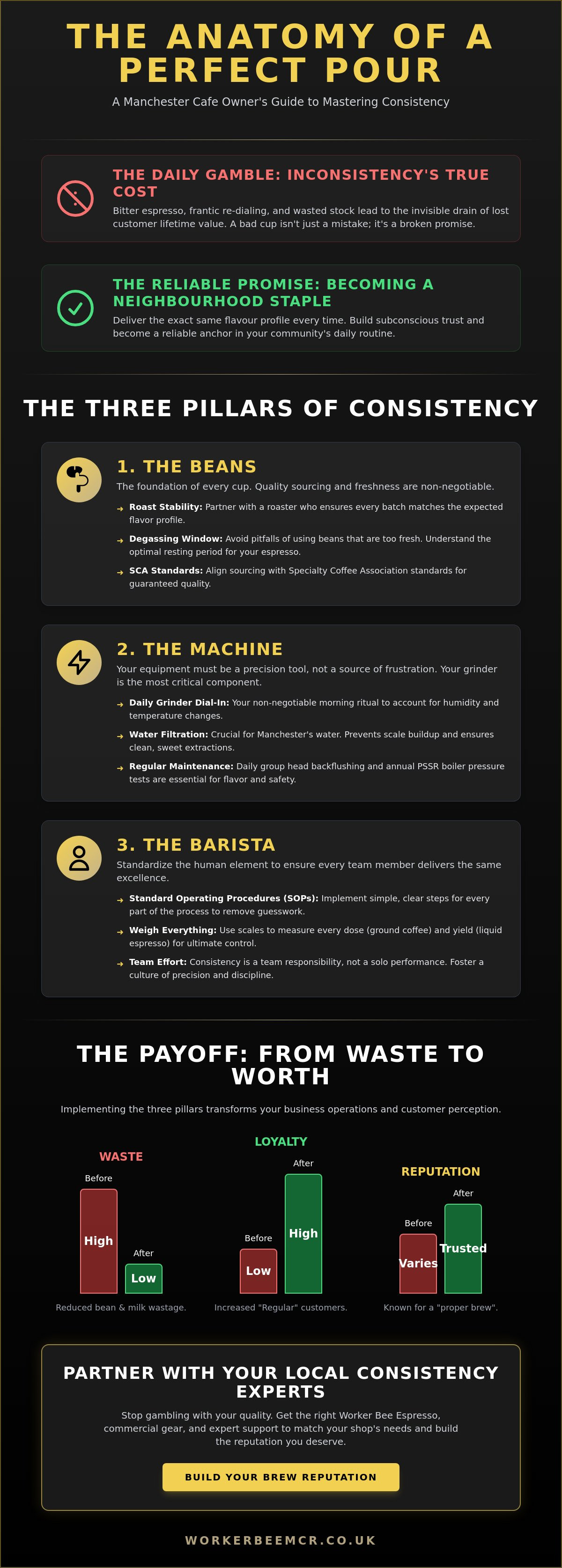
Achieving this level of reliability requires a focus on three specific areas of your operation. If one slips, the whole experience fails. You need a balanced approach to stay ahead.
- The Beans: Roast stability and freshness are non-negotiable. We align our sourcing with Specialty Coffee Association standards to ensure every bag of Worker Bee Espresso delivers the profile you expect. High-quality beans provide the steady foundation your staff needs to succeed.
- The Machine: Your gear must be a precision tool. Your commercial espresso machines and coffee grinders require daily calibration and technical respect to stay within the tight windows of excellence.
- The Barista: Even the best beans fail in untrained hands. Standardising the human element through disciplined habits, like weighing every dose and yield, ensures that getting consistent coffee quality in my cafe is a team effort rather than a solo performance.
Calibrating the Gear: Equipment Maintenance and Setup
Manchester’s industrious spirit doesn't stop at the door. Inside your cafe, your equipment is the heavy lifting crew. While a sleek espresso machine looks the part, your grinder is actually the most critical factor for getting consistent coffee quality in my cafe. If your grind size drifts, even the most expensive beans will taste like a mistake. Daily dialling-in is your non-negotiable morning ritual. It's the moment you align your tools with the day's humidity and temperature before the first customer arrives.
Water chemistry is another silent partner in your success. Manchester’s water has its own character, and without proper filtration, it can lead to scale buildup or flat-tasting extractions. Following Specialty Coffee Association standards ensures your water mineral balance supports the coffee's natural sweetness rather than masking it. Beyond flavor, filtration protects your investment. Under the Pressure Systems Safety Regulations 2000 (PSSR), your boiler requires an annual pressure test and a Written Scheme of Examination. Keeping the internals clean with regular descaling and group head backflushing prevents "off" flavors that drive customers away.
Choosing the Right Commercial Machinery
Selecting a machine isn't just about the brand name. You must match the machine’s capacity to your peak-hour rush. If your boiler can't keep up with a Friday morning surge, thermal instability will ruin your shots. This is why commercial coffee machines need local service support. You need gear that stays stable under pressure. If you're looking to upgrade your setup, checking out our range of commercial espresso machines can help you find a workhorse that fits your volume.
The Grinder: Your Secret Weapon for Uniformity
Burr health is the heartbeat of uniformity. Dull blades produce "fines", which are tiny dust particles that over-extract and turn a brew bitter. On-demand grinders are often the better choice for busy Manchester shops because they reduce waste and ensure every dose is ground fresh. To keep your grind size consistent, check your extraction times every hour. If a shot runs too fast, tighten the grind. If it chokes the machine, coarsen it. Small, decisive adjustments keep your quality on track all day long. Investing in high-quality coffee grinders is the fastest way to eliminate the guesswork from your morning routine.
The Human Element: Training Baristas for Uniformity
Even the best gear in Manchester cannot save a coffee if the human touch is erratic. Your team is the final link in the chain. Training isn't a one-time event; it is a culture of discipline. Getting consistent coffee quality in my cafe depends on Standard Operating Procedures (SOPs) that leave zero room for "gut feelings" or guesswork. When every staff member follows the same blueprint, the customer gets the same honest cup every time, regardless of who is behind the bar.
The scale is your most powerful tool for uniformity. Eyeballing a dose is for amateurs. Every dose of Worker Bee Espresso must be weighed to the gram, and every liquid yield must be measured. Scales don't lie. They provide an objective truth that protects your margins and your reputation. Alongside weight, tamping must be standardised. A level, firm tamp ensures the water flows evenly through the puck. If one barista tamps light and another tamps heavy, your flavor profile will swing wildly. Physical consistency is a badge of honor for a professional team.
Milk texturing requires the same industrious focus. We are looking for "velvet" microfoam, not soapy bubbles. This comes from precise aeration and a disciplined whirlpool technique. Whether it is a flat white or a latte, the texture should be repeatable. This level of craft turns a simple drink into a premium experience that justifies your price point and builds local loyalty.
The Daily Dial-In Workflow
Consistency starts before the doors open. Every shift must begin with a formal dial-in process to account for changes in temperature and humidity. Use this checklist to keep your team on track:
- Step 1: Purge the grinder to clear out any stale, oxidised grounds from the previous day.
- Step 2: Pull a test shot and adjust the grind size based on extraction time and sensory notes.
- Step 3: Lock in the recipe. Write the dose, yield, and time on a visible chalkboard.
This visible recipe ensures that even a mid-day starter knows exactly what the benchmark is for the afternoon rush.
Barista Discipline and Pride
True quality comes when a barista moves from being a "button pusher" to a craftsman. This shift happens through education and tasting. Hold regular sessions where the team tastes the espresso together. When they can identify the difference between an over-extracted bitter shot and a balanced one, they take ownership of the output. Cleanliness is the final pillar. Implementing a "clean as you go" policy prevents old, rancid coffee oils from tainting fresh pours. A clean machine is a sign of a shop that respects its product and its community. Getting consistent coffee quality in my cafe is ultimately about that shared pride in serving something proper.
Beans and Sourcing: Impact of Roast and Freshness
You can own the finest machine in Ancoats, but if your beans are inconsistent, your coffee will be too. The raw material is the soul of every cup. Getting consistent coffee quality in my cafe starts with the roast profile. Working with a local roaster ensures you receive the same flavor notes every week. Large, faceless suppliers often struggle with batch-to-batch uniformity, but a local partner provides the stability your baristas need to dial-in effectively.
Freshness is a double-edged sword. The "degassing" window is a critical period where beans release carbon dioxide. If you use beans roasted yesterday, the trapped gas creates bubbles that disrupt water flow, leading to sour, uneven extractions. Conversely, stale beans lose their aromatic oils and taste flat. The sweet spot usually sits between seven and twenty-one days after roasting. Proper storage is your defense against oxygen and light. Keep your precious cargo in airtight containers in a cool, dark spot to preserve that industrious flavor. For those seeking menu-wide excellence, don't ignore the non-caffeinated crowd. Serving a high-quality Swiss Water Decaf coffee ensures your decaf lattes are just as rich and reliable as your standard pours.
Sourcing for High-Volume Reliability
In a busy shop, reliability beats "experimental" every time. While a funky, fermented roast might offer a one-off "wow" factor, it is often too volatile for high-volume service. Seasonal consistency matters more for business growth. You want a house blend that tastes like home. Developing a strong relationship with your supplier allows you to troubleshoot flavor drifts before they reach the customer. If you are ready to stabilize your supply, you can order Worker Bee Espresso beans to secure a profile your regulars will trust.
Menu Versatility: From Espresso to Filter
Your beans must stand up to milk without losing their character. A roast that is too light will vanish in a large latte, while one that is too dark might taste ashy. Consistency should extend across your entire menu, even to your non-coffee options. Successful coffee shops apply the same standards to their tea and hot chocolate. Whether you are serving a Worker Bee Breakfast Tea or a filter brew, the goal is a "proper brew" every time. Standardising your water-to-leaf ratios for tea is just as vital as weighing your espresso shots. Every drink is a reflection of your brand's commitment to quality.
Partnering with Worker Bee MCR: Your Local Consistency Experts
Manchester is a city of doers. You don't have time for a partner who doesn't understand the grit required to run a successful shop. We designed Worker Bee Espresso specifically for the hard-working Manchester cafe. It is a roast that stands up to the city's busy pace and high expectations. Getting consistent coffee quality in my cafe becomes a lot easier when you have a neighbor in your corner. We don't just drop off bags of beans and disappear. We are committed to supplying the right gear, from heavy-duty commercial espresso machines to precision coffee grinders, tailored to your specific daily volume.
Being based in the heart of the city means we are part of your community. Local support isn't just a buzzword for us. It means less downtime and more "up-time" for your business. If your grinder drifts or you need a fresh perspective on your workflow, we are right here. When you join the swarm, you aren't just a client; you are part of a community-focused approach that helps independent businesses thrive. We believe that when one local shop succeeds, the whole neighborhood feels the benefit.
The Worker Bee Difference
Our mission goes beyond the cup. We believe in great coffee that does good for the city. Through our social impact mission, we support local charities like Forever Manchester and Prevent Breast Cancer UK. This creates a narrative of ethical consumption that your regulars will appreciate. We also provide technical support and machinery expertise specifically for Greater Manchester businesses. Consistency shouldn't stop at espresso. Our curated range of Worker Bee Breakfast Tea and Worker Bee Hot Chocolate ensures your entire menu meets the same high standards we've discussed in this guide. We help you build a menu that is reliable from the first peppermint tea to the last decaf flat white of the day.
Get Started with a Consistency Audit
Sometimes you are too close to the machine to see where things are slipping. We help local cafes identify their "quality leaks" and plug them with better habits or more reliable gear. Whether it is a drift in your grind or a training gap in your team, we can help you find the solution. Getting consistent coffee quality in my cafe is a journey, and we are ready to walk it with you. You can even request a sample of our Worker Bee Espresso to test in your own machine. It is time to stop the guesswork and start serving the proper brew your neighborhood deserves. Join the Worker Bee family and elevate your cafe's quality today.
Take Charge of Your Cafe's Repeatable Excellence
You now have the roadmap to turn every cup into a neighborhood favorite. Success in the Manchester coffee scene isn't about luck; it is about the industrious habits you build every morning. By mastering your daily dial-in, standardising barista training with scales, and choosing beans with proven roast stability, you eliminate the guesswork that eats into your margins. Getting consistent coffee quality in my cafe is a promise of reliability to your regulars. It shows you value substance over style and respect the craft of a proper brew. Every poured heart or rosetta becomes a badge of your team's dedication.
You don't have to tackle these technical challenges alone. We provide the dedicated, Manchester-based support you need to keep your gear running and your hopper full of premium Worker Bee Espresso blends. As suppliers of top-tier commercial machinery, we help you match your equipment to your shop's unique rhythm. Whether you are upgrading a grinder or sourcing ethical beans that do good for our city, we are in your corner. Upgrade your cafe's consistency with Worker Bee MCR and start building the loyal following your hard work deserves. Let's make every pour count.
Frequently Asked Questions
Why does my coffee taste different at different times of the day?
Temperature and humidity shifts throughout the day cause coffee beans to expand or contract. In a busy Manchester shop, the climate changes every time the door opens. These environmental factors alter how water flows through the coffee grounds. If you don't adjust your grind to compensate for these shifts, your flavor profile will drift from sweet to bitter.
How often should my baristas dial-in the coffee grinder?
You should dial-in your equipment at least three times every day. Start before the morning rush, check again at midday, and do a final calibration for the afternoon peak. Getting consistent coffee quality in my cafe requires constant vigilance. Small, frequent adjustments to the grind size ensure that every shot stays within your target extraction window.
Is it necessary to weigh every single coffee shot for consistency?
Weighing every dose and liquid yield is the only way to guarantee a repeatable result. Volumetric buttons on a machine can drift, and bean density changes as the hopper empties. By using a scale, your team removes the guesswork. It ensures that 18 grams of Worker Bee Espresso always results in your specific target yield every single time.
How does humidity in Manchester affect my coffee grind?
High humidity causes coffee grounds to clump together, which slows down the extraction process. Manchester's famously rainy weather often makes the grind run tighter and slower. When the air is damp, you might need to coarsen your grind setting slightly. Monitoring the weather helps you anticipate these changes before the coffee starts tasting over-extracted and harsh.
What is the best way to train new baristas on consistency?
Start with a clear Standard Operating Procedure (SOP) that focuses on technical basics rather than flair. Focus on dose weight, distribution, and a level tamp. New starters should spend their first shifts mastering these repeatable physical movements. Once they can hit the target yield consistently, they can move on to milk texturing and more complex tasks.
Does the type of milk I use affect the consistency of the coffee flavour?
Different milk brands and fat contents change how the coffee's natural notes are perceived by the customer. A high-protein milk produces better microfoam, while a lower-quality alternative might taste watery. If you switch suppliers, you may need to tweak your espresso recipe. This ensures the coffee still cuts through the milk correctly without losing its character.
How can I tell if my commercial espresso machine needs professional servicing?
Look for signs like inconsistent pump pressure, leaking group heads, or unstable water temperatures. Under PSSR 2000 regulations, your machine also needs an annual pressure test conducted by a certified engineer. If you notice a metallic taste or a drop in steam power, it is time for a professional checkup. Regular maintenance prevents the "off" flavors that ruin a proper brew.
Can a cheaper grinder be the cause of my inconsistent coffee quality?
A low-quality grinder is often the primary reason for getting consistent coffee quality in my cafe being a struggle. Cheaper models often have poor burr alignment, which produces a mix of coarse chunks and fine dust. This leads to uneven extraction and muddy flavors. Investing in professional coffee grinders ensures a uniform particle size, which is the foundation of a balanced cup.