

How Much Coffee Does an Office Need? The 2026 UK Workplace Guide
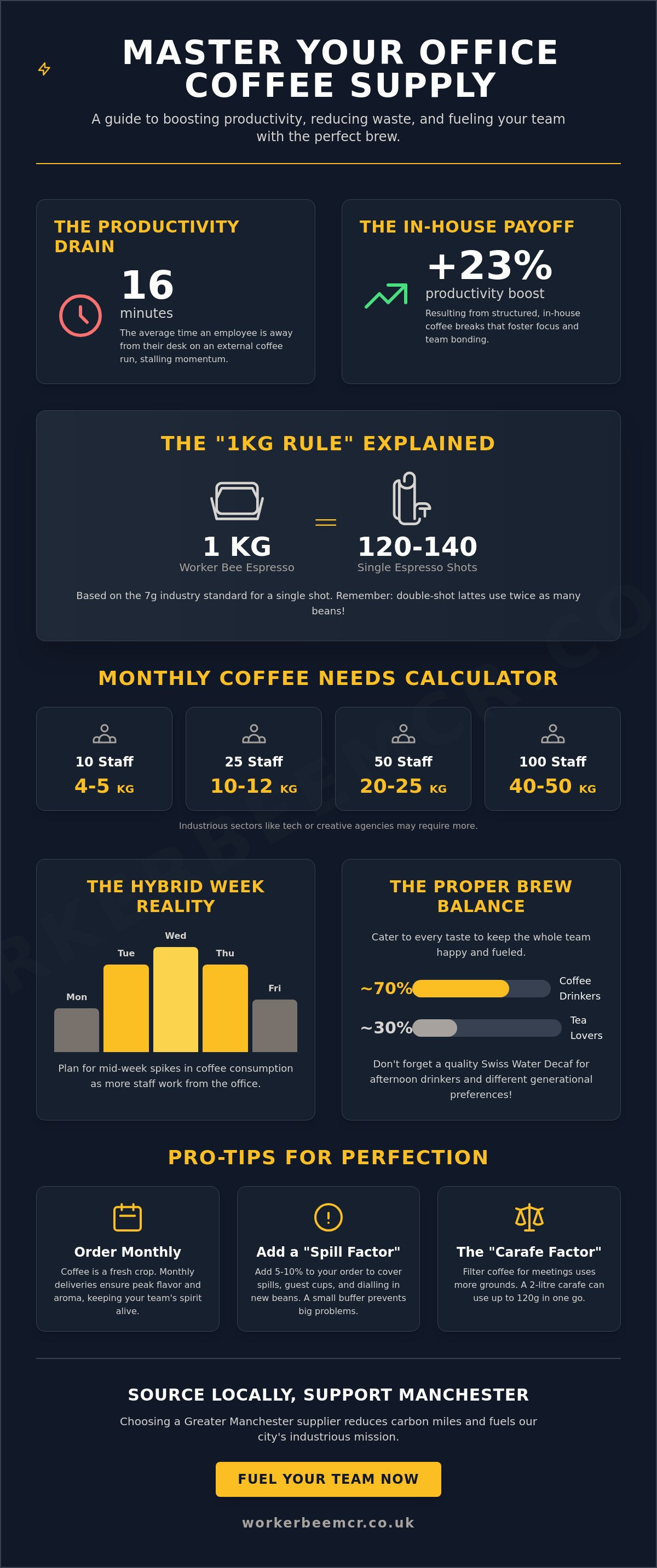
Did you know the average employee spends 16 minutes away from their desk every time they nip out for a professional flat white? Over a week, those quick trips drain the industrious spirit of your team and leave your productivity looking a bit thin. Figuring out exactly how much coffee does an office need UK wide is more than just a stocking exercise. It's about keeping the heart of your workplace beating without wasting a single bean or letting quality slip.
We know the struggle of the mid-week panic when the Worker Bee Espresso runs low, or the frustration of finding stale bags tucked at the back of the cupboard. You want to provide a perk that matters while keeping an eye on the budget and your social impact. This guide promises to help you master the math of your office supplies so you can reduce waste and keep everyone from the early birds to the late-shifters properly fuelled. We will break down the 2026 cup-per-head formula, look at balancing Worker Bee Breakfast Tea with specialty decaf, and explain how ethical sourcing creates a happier, more connected community.
Key Takeaways
- Master the 1kg rule. One bag of Worker Bee Espresso delivers roughly 120 to 140 servings, so you can stop over-ordering and keep your beans fresh.
- Apply the 2026 hybrid formula to calculate exactly how much coffee does an office need UK wide, specifically planning for busy mid-week spikes.
- Cater to every taste by stocking a proper Breakfast Tea and Swiss Water Decaf, ensuring the 30% of tea-lovers and afternoon drinkers aren't left behind.
- Support the local community. Sourcing your office fuel from Greater Manchester reduces carbon miles and fuels our city's industrious mission.
Understanding UK Office Coffee Consumption in 2026
The standard for a proper workplace brew has shifted. In 2026, a jar of instant or a bag of dusty supermarket grounds simply doesn't cut it. Your team works hard, and they expect their fuel to do the same. When managers ask how much coffee does an office need UK wide, they're really asking how to sustain a culture of excellence. The current benchmark is high-quality, ethically sourced beans that taste as good on a rainy Tuesday as they do on a sunny Friday. On average, UK workers now consume 2.5 cups of coffee every single day while they're at their desks. That’s a lot of beans, and it's a lot of opportunity to do things right.
Settling for commodity coffee fails the industrious spirit of a modern Manchester team. We’re a city built on hard work and community; our coffee should reflect that legacy. Understanding the global coffee market helps us see that quality and ethics go hand in hand. If you buy cheap, you're likely missing out on the transparency that ensures farmers get a fair deal. Plus, supermarket coffee is often roasted months ago. It lacks the punch and personality of Worker Bee Espresso. A proper coffee station is the new Watercooler 2.0. It’s where ideas spark and teams bond over a shared appreciation for a decent drink.
The Productivity Payoff
Investing in Worker Bee Filter or a high-end commercial machine isn't just a perk. It’s a business strategy. A study from the University of Leeds found that structured coffee breaks lead to a 23% boost in productivity. When you provide barista-quality options in-house, you also stop the "coffee run" drain. Every time an employee leaves for 16 minutes to find a decent latte, your momentum stalls. A proper brew culture supports mental health too. It gives people a reason to step away, reset, and return to their tasks with fresh focus.
Generational Coffee Habits
Calculating how much coffee does an office need UK requires looking at who is actually in the building. Gen X and Boomer staff often lean towards high-volume consumption, sticking to reliable filter options throughout the morning. Meanwhile, Gen Z workers often prioritise quality over quantity. They're looking for specialty origins, ethical beans, and Worker Bee Swiss Water Decaf for the afternoon. You don't need to triple your inventory to keep everyone happy. By choosing a versatile, high-quality staple like Worker Bee Espresso, you satisfy the connoisseurs and the volume drinkers alike without the waste.
The Office Coffee Calculator: How Much to Order
Stop guessing and start measuring. Getting your ordering right saves money and prevents the dreaded "empty hopper" crisis on a busy Wednesday. When looking at UK office coffee consumption statistics, it's clear that workplace habits are consistent, yet many offices still over-order. A standard 1kg bag of Worker Bee Espresso provides roughly 120 to 140 single shots. The industry standard for a single espresso shot is exactly 7g of coffee grounds. If your team prefers double-shot lattes, that bag will vanish twice as fast.
Freshness is non-negotiable for a proper brew. Coffee is a fresh crop, not a tinned good. Ordering beans for more than four weeks is a mistake because they lose their punch and aroma once the seal is broken. Aim for a monthly delivery to keep the quality high and the industrious spirit of your team alive. Don't forget "The Spill Factor" either. Always add an extra 5% to 10% to your total to cover dialling in the machine, guest cups, and the occasional spill. It's better to have a small buffer than to run dry when a client visits.
The Kilo-to-Staff Ratio
Your team's industry changes the math. Industrious sectors like tech, construction, or creative agencies often drink more than the national average. If your crew is pulling long shifts or working through complex builds, lean towards the higher end of these estimates. Here is a quick guide to help you decide how much coffee does an office need UK wide based on headcount.
| Staff Size | Estimated Monthly Beans (kg) |
|---|---|
| 10 Staff | 4 - 5kg |
| 25 Staff | 10 - 12kg |
| 50 Staff | 20 - 25kg |
| 100 Staff | 40 - 50kg |
Filter Coffee vs. Espresso Beans
Filter coffee works differently. It generally requires more grounds per litre than an espresso shot to get that full-bodied flavor. If you use a carafe for large meetings, you'll burn through Worker Bee Filter faster than you think. We call this the "Carafe Factor." A single 2-litre carafe can use up to 120g of coffee in one go. Choosing the right equipment is just as important as the beans. You can check out our guide on commercial coffee machines to see which setup fits your team's volume. Bean-to-cup machines are great for consistency, but they often use slightly more beans per cup than a manual setup because of the internal cleaning and purging cycles. If you're ready to upgrade your supply, take a look at our Worker Bee Espresso options to keep your team moving.
Adjusting for the 2026 Hybrid Work Reality
The traditional five day office week is a thing of the past. In 2026, the hybrid model is the standard for most UK businesses. This shift makes answering how much coffee does an office need UK wide a bit more technical than just counting heads. You likely see empty desks on Mondays and a full house by Wednesday. If you order based on your total headcount, you'll end up with stale beans. If you order based on the quiet days, you'll run out by Thursday lunch. It's a balancing act that requires a bit of industrious planning.
To get your ordering right, use this simple formula: (Total Employees x Average Days in Office) / 5 = Adjusted Daily Headcount. For example, if you have 50 staff but they each only come in three days a week, your daily average is 30 people. However, you shouldn't just order for 30. You have to account for the "Tuesday-Thursday Spike" when almost everyone is in the building at once. Freshness is king here. We recommend keeping your stock levels lean on Mondays and Fridays to ensure the beans you use during the mid-week rush are as fresh as possible.
Managing the Mid-Week Rush
Your machine capacity must match your peak days, not your average days. If 45 people want a latte at 9:00 AM on a Tuesday, a machine designed for 20 will struggle to keep up. It’s about making sure your team isn't queuing out the door for their morning fuel. Ensure you have plenty of Worker Bee Espresso ready for the mid-week meeting blitz. We also suggest a "Monday Morning" maintenance routine. Clean the group heads and check your grinders before the rush starts to ensure zero downtime when it matters most.
The Cost of Over-Ordering
Big bags of beans might look like a bargain, but they're a waste if they lose their punch. Oxygen is the enemy of flavour. Once a bag is opened, the clock starts ticking on those sensory-rich oils. For Manchester offices, storage is also a factor. Avoid keeping your beans near damp areas or heat sources like dishwashers. Use the "First In, First Out" (FIFO) method in your coffee cupboard. Put the newest bags at the back so you're always using the oldest stock first. A subscription model often fits the hybrid reality best. It keeps your inventory lean and ensures a steady stream of fresh beans without the risk of over-stocking.
The Proper Brew Balance: Tea, Decaf, and Ethics
While we've spent time calculating kilos of beans, a modern office isn't a one-trick pony. We’re a nation of tea lovers too. In fact, 25-30% of UK office workers still reach for a proper brew over a flat white. If you only stock espresso, you’re alienating a huge chunk of your team. Providing a variety of drinks prevents menu fatigue. It keeps your staff from wandering to the high street every time they want something different. It's about showing kindness through variety and making sure everyone feels seen in the staff room.
When you're trying to figure out how much coffee does an office need UK wide, you have to account for the non-caffeine drinkers and the afternoon switchers. A balanced cupboard is the mark of an office that actually understands its people. It’s not just about stocking the basics; it’s about providing high-quality alternatives that match the industrious spirit of your workplace. From herbal infusions for wellness to a rich decaf for the 3 PM slump, variety is what keeps the team fuelled and happy.
Calculating Your Tea and Decaf Split
Finding the right balance is simpler than it looks. A solid rule of thumb is to order one box of Worker Bee Breakfast Tea for every 2kg of coffee beans you buy. As the clock ticks on, tastes shift. About 10-15% of total coffee consumption usually moves to decaf after 2 PM. This is where Swiss Water Decaf becomes a non-negotiable. It offers the same sensory-rich flavour as our standard espresso but without the late-night jitters. For a complete wellness offering, ensure you have Worker Bee Peppermint and Lemon & Ginger on hand to support those looking for a refreshing, caffeine-free lift.
Sustainability in the Staff Room
Sustainability isn't just a buzzword; it’s a commitment to our city and the planet. Modern ESG goals mean businesses are looking for ethical partners who share their values. Worker Bee isn’t just a brand. It’s a mission to support the Greater Manchester community through every cup sold. By choosing ethical roasters, you boost your company reputation and ensure farmers are treated fairly. You can also slash single-use waste by providing branded Worker Bee Mugs or Worker Bee Reusable Cups. These small changes show your team that your ethics go beyond a tick-box exercise. You can start building a more responsible workplace by stocking up on our Worker Bee Breakfast Tea and Swiss Water Decaf today.
Sourcing Your Office Fuel from Greater Manchester
Choosing a local partner is the final piece of the puzzle. Once you've crunched the numbers to figure out how much coffee does an office need UK wide, you want a supplier who understands the local pace. Greater Manchester isn't just a location for us; it’s our home. Sourcing your fuel locally means your beans haven't been sitting in a national distribution centre for weeks. They’re roasted, packed, and delivered with the industrious spirit this city is famous for. It ensures your team gets the freshest possible Worker Bee Espresso without the wait.
Local supply chains aren't just about speed. They're about responsibility. By keeping things in the North West, we significantly lower the carbon footprint of every cup. It’s a cleaner, kinder way to keep your team moving. Worker Bee was built for the people who make this city move. Whether you're in a high-rise in Deansgate or a workshop in Salford, you deserve a brew that reflects your hard work. We anchor our identity in community impact, ensuring that every bag of beans serves a larger purpose beyond just a caffeine hit.
We don't just drop off bags and disappear. Our team, led by Roger, offers a bespoke "Office Coffee Audit" to help you refine your ordering. We look at your headcount, your machine type, and your team's tastes to ensure zero waste. Determining how much coffee does an office need UK wide is easier when you have a local expert on speed dial. We also supply the professional gear you need to do the job right, from precision Coffee Grinders to high-performance Commercial Espresso Machines.
The Worker Bee Advantage
We handle our own deliveries across Greater Manchester. This means you avoid the national courier lottery and the risk of damaged goods. Our service is personal and reliable. We also help you build a cohesive office culture with our range of accessories. Stocking your kitchen with Worker Bee Mugs and Worker Bee Reusable Cups sends a clear message about your brand's loyalty to its roots. Businesses from Stockport to the city centre tell us that having a local, ethical supplier makes a massive difference to staff morale and their own ESG reporting.
Next Steps: Setting Up Your Supply
Transitioning from supermarket beans to a professional wholesale account is a game-changer for any workplace. It moves you from "making do" to "doing it right." We provide the training your team needs to use our commercial machines, ensuring every cup is world-class. It’s time to stop the mid-week runs to the high street and start brewing something better in-house. You can get a tailored coffee quote for your Manchester office today and let us help you fuel your industrious team.
Fuel Your Office Community
Getting your ordering right is about more than just filling the cupboard. It’s about ensuring your team never hits that mid-week slump without a proper brew in hand. By mastering the kilo-to-cup ratio and accounting for hybrid work spikes, you can finally answer how much coffee does an office need UK wide with total confidence. Remember to balance your espresso with Worker Bee Breakfast Tea and our ethical Swiss Water decaf to keep every member of your industrious crew satisfied and productive.
We’ve been Manchester-born and bred since 2017. We don’t just sell beans; we supply professional machines to Greater Manchester’s finest workplaces and support our local community with every delivery. Transitioning to a local, ethical supplier reduces your waste and boosts your office culture. It’s time to ditch the supermarket grounds and invest in quality that reflects your team's hard work. Fuel your industrious team with Worker Bee coffee today and see the difference a proper local partnership makes to your workday. Let's keep our city moving, one cup at a time.
Frequently Asked Questions
How many grams of coffee are in a standard UK office cup?
A standard single espresso shot in a UK office uses exactly 7g of coffee grounds. If your team prefers double-shot drinks like lattes or flat whites, you'll need 14g per cup. For those using filter machines, the best practice is to use 60g of grounds for every litre of water to ensure a full-bodied and sensory-rich flavour.
Does coffee go off if we order too much for the office?
Coffee beans are a fresh agricultural product and will lose their punchy aroma and oils over time. Once you open a bag, the quality starts to dip within two to four weeks due to oxygen exposure. We advise ordering smaller, monthly batches rather than stocking up for months to keep your team fuelled by the freshest beans possible.
What is the best type of coffee machine for a 20-person office?
A high-quality bean-to-cup commercial espresso machine is usually the best fit for a 20-person office. These machines handle the grinding and brewing at the touch of a button, which keeps the kitchen clean and the drink quality consistent. It’s a reliable choice that ensures everyone gets a barista-quality drink without needing professional training.
How much tea should I order compared to coffee?
You should typically order one box of Worker Bee Breakfast Tea for every 2kg of coffee beans you buy. While coffee is the main driver for many, tea remains a staple for about a third of workers in the UK. Keeping this ratio ensures you don’t run out of a proper brew while also avoiding a cupboard full of unused stock.
Is decaf coffee necessary for a productive workplace?
Decaf is essential for maintaining productivity without the late-day jitters that can disrupt focus. Many employees switch to decaf after 2 PM to stay hydrated and alert without affecting their sleep later that night. Providing a high-quality option like Worker Bee Swiss Water Decaf shows kindness to your team's well-being and supports a healthier work culture.
How do I calculate coffee needs for a hybrid office in 2026?
To figure out how much coffee does an office need UK wide in a hybrid setup, calculate your average daily attendance but stock for your busiest peak days. If your whole team is in on Tuesdays and Wednesdays, your supplies must meet that specific demand. Use our adjusted headcount formula and add a 10% buffer to cover guest meetings and busy project launches.
Can I get a discount for buying coffee in bulk for my business?
Setting up a professional wholesale account with a local roaster always offers better value than buying individual retail bags. While we don't suggest over-ordering to the point of staleness, committing to a regular monthly volume allows us to provide more competitive rates for your business. It’s a smart way to balance a high-quality perk with a sensible budget.
Why should I choose a local Manchester coffee supplier?
Choosing a local Manchester supplier means your beans are roasted nearby and delivered quickly, ensuring peak freshness for every cup. It slashes your carbon footprint by avoiding long-haul national couriers and keeps your investment within the local economy. We’re proud to be Manchester-born and bred, and we believe our city’s industrious teams deserve a brew that shares their roots.