
How to Make the Perfect Espresso for Customers: The Barista’s Guide to Consistency
A "perfect" espresso isn't a stroke of luck or a barista's intuition; it's a disciplined, repeatable system. Learning how to make the perfect espresso for customers is the difference between a one-off visit and a loyal regular who wouldn't dream of going anywhere else. We understand the grit it takes to handle a morning rush when shots start running bitter and expensive beans end up in the bin. You need a workflow that works as hard as you do, rooted in regional pride and the drive to serve a proper brew every single time.
We agree that consistency is the heartbeat of any successful shop. This guide promises to help you master the professional techniques and workflow secrets required to serve a flawless shot without the guesswork. We'll explore the latest SCA standards for water temperature and quality, alongside zero-waste dialling-in methods that protect your margins and reduce waste. You'll learn how to use your coffee grinders to their full potential, ensuring your staff stay confident and your community gets the quality they deserve. It's time to turn that morning rush into a well-oiled machine.
Key Takeaways
- Master the 'Holy Trinity' of extraction by using a precise 18-20g dose of Worker Bee Espresso to ensure every cup delivers a proper brew that hits the mark.
- Learn how to make the perfect espresso for customers by adopting a 'clean-in, clean-out' workflow that guarantees consistency during the busiest morning shifts.
- Eliminate sour or thin shots by mastering distribution techniques that stop channelling and ensure a balanced, even extraction.
- Develop your palate to distinguish between under-extracted acidity and over-extracted bitterness, using visual cues like 'tiger-striped' crema as your guide.
- Understand why measuring liquid yield in grams, rather than volume, is the only way to account for crema variations and keep your quality high.
The Holy Trinity of Commercial Espresso: Dose, Yield, and Time
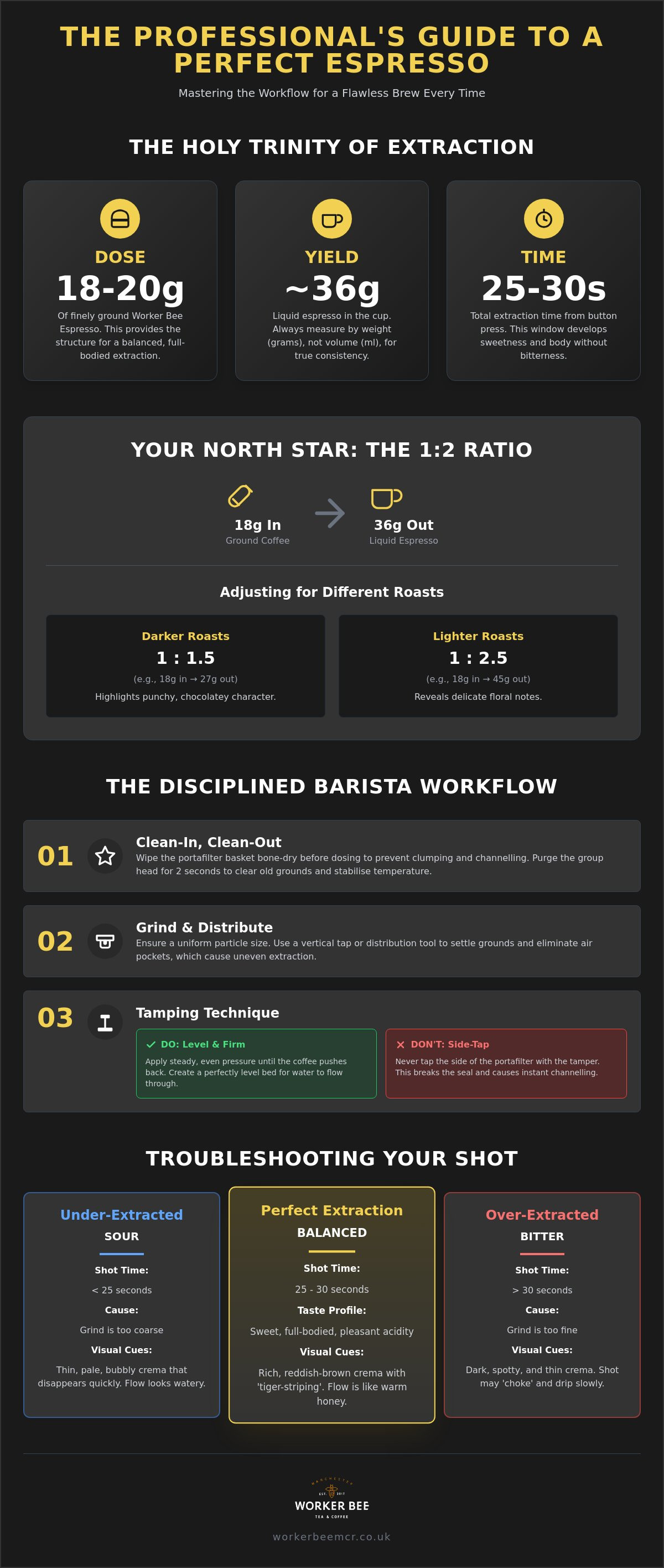
Precision isn't about being fussy. It's about respect. Respect for the beans, the craft, and the hard-working customer waiting at your counter. To understand how to make the perfect espresso for customers, you must master three non-negotiable variables: dose, yield, and time. Whilst the history of espresso is steeped in tradition, modern consistency relies on a digital scale. Eyeballing a shot in a busy Manchester cafe is a recipe for inconsistent flavour and wasted stock. We recommend a dose of 18-20g of Worker Bee Espresso. This weight fits most commercial baskets perfectly, providing the structure needed for a balanced, full-bodied extraction.
Forget measuring by millilitres. Crema is beautiful, but it's mostly trapped CO2 that fluctuates based on roast date and humidity. It's a liar. Instead, weigh your liquid yield in grams to ensure accuracy. Aim for an extraction time of 25-30 seconds. This window allows the hot water to pull out the natural sweetness and body without letting bitter, over-extracted notes ruin the finish. It's the foundation of every proper brew we serve across the city.
Setting Your Recipe for the Day
Coffee Grinders don't stay still. As your shop warms up and the humidity shifts, your grind will wander. Dialling-in isn't just a morning chore; it's a constant conversation with your equipment. Run two or three test shots before you open the doors to ensure the flow is spot on. If the shot runs too fast, tighten the grind. If it chokes, coarsen it up. This proactive approach saves you from wasting expensive beans whilst customers are watching.
Understanding the Ratio
The 1:2 ratio is your North Star. If you put 18g of ground coffee into the portafilter, you want 36g of liquid coffee in the cup. It's the industry standard for a reason. It balances strength with clarity. However, don't be afraid to tweak it slightly. Darker roasts often shine with a shorter 1:1.5 ratio to highlight their punchy, chocolatey character. For lighter specialty origins, stretching to 1:2.5 can reveal hidden floral notes. Trust your palate, but use the scale to stay consistent.
Mastering the Barista Workflow for Speed and Quality
Speed is nothing without accuracy. During a frantic morning rush in the city centre, it is far too easy to cut corners. Don't. A disciplined, rhythmic workflow is exactly how to make the perfect espresso for customers when the queue is out the door. Start with the 'Clean-In, Clean-Out' rule. Every single portafilter must be wiped bone-dry before you dose. Moisture causes ground coffee to clump, leading to channelling where water finds the path of least resistance. This results in a shot that is both sour and watery. A quick 2-second purge of the group head before locking in ensures you are brewing at the stable temperatures defined by The Holy Trinity of Commercial Espresso.
This grit and attention to detail separate the professionals from the amateurs. It's about being an expert who cares. By purging the group head, you clear away old oils and grounds that would otherwise taint the fresh flavour of your Worker Bee Espresso. It's a small step that makes a massive difference to the final cup.
Grinding and Distribution
Your coffee grinder is the real engine of your cafe. If the particle size isn't uniform, your extraction will never be consistent. For speed, a 'Vertical Tap' on the counter can settle grounds quickly, but dedicated distribution tools are better for eliminating air pockets. These pockets are the enemy of a proper brew. They create weak spots in the coffee puck where water rushes through too fast. If you're looking to upgrade your setup, check out our range of professional coffee grinders to keep your workflow sharp and your shots sweet.
Tamping Technique
Tamping isn't a test of sheer muscle power. It's about creating a perfectly level bed of coffee. Water is lazy; it will always take the easiest route. If your tamp is even slightly slanted, the water will favour the thin side, leaving the rest of the coffee under-extracted. Apply firm, steady pressure until you feel the coffee push back. Never 'side-tap' the portafilter with your tamper whilst the coffee is in the basket. This breaks the seal between the coffee and the metal wall, causing immediate channelling. Keep it level, keep it clean, and keep the quality high for every neighbour who walks through your door.
Troubleshooting and Serving: The Worker Bee Standard
The final moment of truth happens before the cup ever touches the saucer. You've dialled in your dose and perfected your tamp, but you still need to keep a sharp eye on the pour. Identifying visual cues is a vital part of how to make the perfect espresso for customers. Look for that elusive 'tiger-striped' crema. Those dark, flecked patterns are a badge of honour. They signal a balanced extraction and rich oils. If the crema is pale and thin, or dark and oily with a hole in the middle, your shot isn't ready for the floor.
Your palate is your most honest tool. If a shot tastes 'sour' or sharp like a lemon, it's under-extracted. You likely need to grind finer. If it's 'bitter' and leaves a dry, ashy feeling on your tongue, it's over-extracted. In a busy shop, we don't just serve drinks; we serve excellence. That means being brave enough to bin a bad shot and start again. It's about honesty and pride in the craft. Our community deserves nothing less than a proper brew every time they visit.
Common Extraction Errors
Keep an eye out for the 'Gusher'. This is when the coffee pours out too fast and looks watery. It usually means your grind is too coarse or your dose is too low. On the flip side, the 'Dripper' happens when the machine is choked. The grind is so fine that the water can't get through, resulting in a dark, burnt mess. Adjust your coffee grinders in small increments. A tiny shift can be the difference between a disaster and a masterpiece.
The Customer Experience
Serving Excellence to Your Local Community
Consistency isn't a happy accident. It's the result of mastering the Holy Trinity of dose, yield, and time, whilst maintaining a workflow that prioritises cleanliness and speed. By focusing on a level tamp and a dry portafilter, you eliminate the variables that lead to bitter or sour shots. Mastering how to make the perfect espresso for customers transforms your shop into a destination where quality is guaranteed; shot after shot. Every proper brew you serve is a handshake with your neighbour, built on trust and professional pride.
We're here to help you nail that consistency every single day. As a Manchester-based business, we provide full support and commercial equipment supply for North West businesses. We're already trusted by some of the most iconic coffee shops in Manchester for our premium beans and reliable service. It's time to upgrade your cafe's coffee service with Worker Bee Espresso beans and professional equipment. Let's work together to keep the city caffeinated and thriving. Your next flawless extraction starts with the right partner.
Frequently Asked Questions
Why does my espresso taste bitter even though I followed the recipe?
Bitterness is almost always a sign of over-extraction. If your dose and time are correct, check your water temperature; it should stay between 90°C and 96°C. Temperatures above this can scorch the grounds and ruin the flavour. Another common culprit is old coffee oils trapped in the group head or portafilter. A quick flush and a clean basket ensure the sweet, chocolatey notes of your Worker Bee Espresso shine through without any burnt aftertaste.
How often should I dial-in my coffee grinder during a shift?
You should dial-in your coffee grinder at least three times during a standard shift. The morning setup is just the start. As the cafe warms up and the humidity shifts, the beans behave differently and the grind will need adjusting. A midday check and a late afternoon tweak are essential to maintain quality. This habit is a core part of how to make the perfect espresso for customers, ensuring the first shot of the day is as good as the last.
Do I really need a scale to make a good espresso for customers?
Using a scale is non-negotiable if you want to be a professional. Crema is mostly trapped gas and its volume changes based on how fresh the beans are. If you measure by sight alone, you will serve inconsistent drinks that frustrate your regulars. A scale ensures that an 18g dose always results in the correct liquid weight in the cup. It is the simplest way to show your neighbours that you value their experience and your craft.
What is the difference between a double espresso and a ristretto for a customer order?
It all comes down to the brew ratio. A standard double espresso usually follows a 1:2 ratio, whilst a ristretto is a "restricted" shot with a 1:1 or 1:1.5 ratio. This means less water passes through the same amount of coffee grounds. The result is a smaller, more intense drink with a thick, syrupy texture. It highlights the sweetness and body of the coffee whilst cutting out the heavier, bitter notes found in longer extractions.