
How to Prevent Coffee Machine Limescale Buildup: The Ultimate Guide for 2026
Did you know that 98% of your morning espresso is actually water? It sounds simple, but those invisible minerals are often a silent killer for your commercial gear. If you don't take steps to prevent coffee machine limescale buildup, you're looking at more than just a bitter cup of coffee. You're looking at inconsistent temperatures, failing boilers, and repair bills that could've been avoided with a bit of grit and the right knowledge. It's frustrating to see a hard-working machine struggle because of something as basic as water chemistry.
We know your machine is the heart of your daily hustle and a vital part of your local community. You want to serve a quality cup every single time, and we're here to help you do exactly that. This guide will show you how to protect your investment and keep your brews tasting sharp. We'll walk through the maintenance routines that actually work, explain which water filters are worth your time, and break down the new prEN 18312 hygiene standards introduced in January 2026. Let's get your equipment running as smooth as a fresh pour.
Key Takeaways
- Learn why calcium carbonate is a silent killer for Manchester boilers, forcing heating elements to work harder until they eventually fail.
- Identify the right filtration systems to prevent coffee machine limescale buildup, whether you're running a busy cafe or a home setup.
- Master simple daily habits like flushing group heads to keep mineral deposits from settling and ruining your morning brew.
- Understand why high-throughput commercial machines need different softening strategies than smaller domestic equipment.
- Ensure your commercial espresso machine stays in top shape by combining the right gear with proactive water management.
The Silent Killer: Why Limescale Buildup Ruins Your Coffee
Limescale isn't just a bit of harmless white dust. It's a mechanical disaster waiting to happen inside your boiler. Most people see a bit of crust on a kettle and think nothing of it, but in a high-pressure espresso environment, it's a different story. This substance is primarily calcium carbonate. It crystallises the moment your water hits those high brewing temperatures, turning liquid minerals into solid rock that clings to every metal surface it can find. If you don't take action to prevent coffee machine limescale buildup, you're essentially letting your machine's heart clog up with stone.
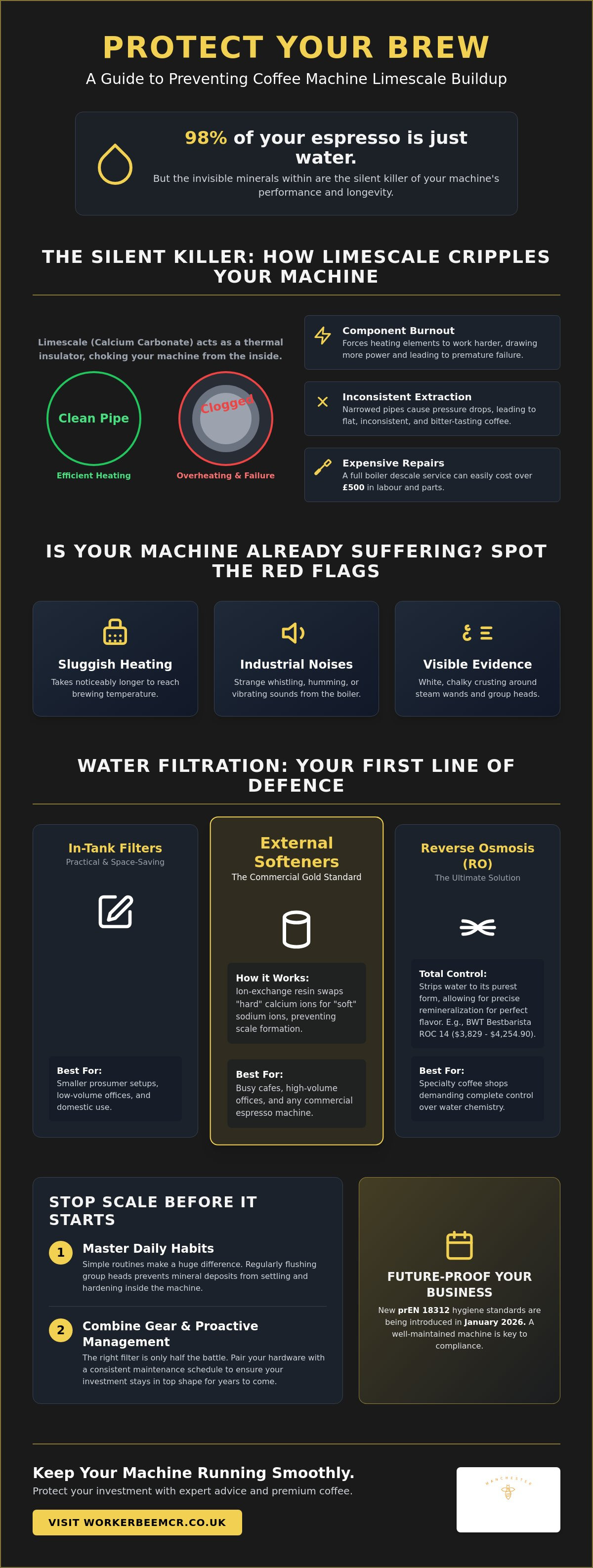
This buildup acts as a powerful thermal insulator. Instead of your heating element warming the water directly, it has to heat a thick layer of rock first. This forces the machine to work overtime, drawing more power and putting immense strain on the components until they eventually burn out. Beyond the energy waste, scale physically narrows your pipes. It's like trying to run a marathon while breathing through a straw; your water pressure drops, and your extraction consistency disappears. You might start with a perfect shot, but by the end of the week, your machine is struggling to keep up with the morning rush.
The Science of Hard Water
Understanding the water in your pipes is the first step toward a healthier machine. Water hardness is split into two types: temporary and permanent. Temporary hardness is the real enemy here because it precipitates out of the water as soon as it's heated. This is why your boiler is the most vulnerable spot in the entire system. What is Limescale? It's a chemical reaction that accelerates with every degree the temperature rises. Limescale is the number one cause of commercial machine failure in the UK. Without a solid strategy to prevent coffee machine limescale buildup, even the most expensive gear won't survive the year.
The Taste of a Choking Machine
We craft our Worker Bee Espresso to deliver a specific, punchy profile that reflects our industrious spirit. Limescale ruins that hard work. It introduces a chalky, bitter "off-flavour" that masks the delicate notes of the bean. It also messes with the water's ability to extract oils properly. You end up with a brew that's flat, inconsistent, and frankly, not up to the standards your customers expect from a local business that cares.
Signs Your Machine Already Has a Scale Problem
You don't always need to open the boiler to know there's trouble brewing. Keep a sharp eye out for these red flags:
- Sluggish heating: It takes noticeably longer for your machine to reach the correct brewing temperature in the morning.
- Industrial noises: You hear strange whistling, humming, or vibrating sounds coming from the boiler as it heats.
- Visible evidence: Look for white, chalky crusting around the steam wands or the edges of the group heads.
If you're noticing these signs, the minerals have already started to take hold. It's time to get serious about your maintenance routine before a small problem becomes a total breakdown.
Water Filtration: Your First Line of Defence
Think of water filtration as the shield for your boiler. In Manchester and across the North West, our water has a character all its own. While we often boast about our soft water compared to the south, the reality is that mineral content varies street by street. To effectively prevent coffee machine limescale buildup, you need a system that actually removes the problem rather than just masking it. Relying on luck is a quick way to end up with a dead heating element and a closed shop. We've seen too many good machines sidelined because of poor water management.
For most local cafes and high-volume offices, external water softeners are the gold standard. These large canisters sit under the counter and treat every drop of water before it ever touches your machine. If you're running a smaller "prosumer" setup or a low-volume office machine, in-tank filters offer a practical, space-saving alternative. For those who demand total control over every variable, Reverse Osmosis (RO) systems are the ultimate solution. These systems, often priced between $3,829 and $4,254.90 for high-end commercial models like the BWT Bestbarista ROC 14, strip water back to its purest form before remineralizing it for the perfect flavor profile.
Ion-Exchange Softeners Explained
This is where the real chemistry happens. Ion-exchange softeners use resin beads to swap out "hard" calcium and magnesium ions for "soft" sodium or hydrogen ions. It's an industrious process that keeps your boiler clean. For a busy commercial setup, this isn't just a technical choice; it's a financial one. Preventing a boiler descale service, which can easily cost over £500 in labor and parts, makes the investment in a good softener a no-brainer. Keeping your Commercial Espresso Machines protected ensures you're always ready for the morning rush without the threat of a breakdown.
Carbon vs. Ceramic Filters
Don't get confused by standard carbon filters. While they're great at removing chlorine and making your water taste better, they do almost nothing to stop limescale. You need a dedicated scale inhibitor. According to the official water hardness levels, even "moderately hard" water can cause significant damage over time. Choosing a filter tailored to the North West's specific profile ensures you're catching the right minerals. Remember, a filter is only as good as its last change. Stick to a strict replacement schedule to ensure you continue to prevent coffee machine limescale buildup effectively. Don't wait for the light to flash; stay ahead of the game and keep the coffee flowing.
Daily Habits to Stop Scale Before It Starts
Maintenance isn't a chore; it's a mark of respect for your gear. If you want to prevent coffee machine limescale buildup, you have to embrace the daily hustle. It's the small, repetitive actions that stop minerals from turning into a thick crust. Start by flushing your group heads after every single service. When water sits stagnant in those hot pathways, minerals find a home. A quick three-second flush keeps the water moving and prevents mineral settling before it has a chance to bond to the metal.
Steam wands are another hotspot for trouble. Purge them immediately after every use. If you don't, milk residue can fuse with rising scale, creating a stubborn, hygienic nightmare that's a struggle to clear. Even for your morning rinse cycles, always use your filtered supply. Feeding raw tap water into a hot machine, even for a moment, invites the enemy inside. Regular backflushing also plays a vital role. It keeps the internal valves and pathways clear of coffee oils and debris that might otherwise act as a foundation for scale to grow on.
The End-of-Day Routine
Your shift doesn't end until the machine is properly settled. Empty and rinse that drip tray to stop external crusting from taking hold. Wipe down the entire body with a fresh, damp cloth to remove splash-back before it hardens into a permanent stain. In a busy office environment, maintaining this level of hygiene often goes hand-in-hand with professional office maintenance; you can learn more about HERA Cleaning to see how expert cleaning services ensure a spotless workplace. One of the biggest silent issues is leaving water sitting in the boiler overnight. As the machine cools, the solubility of minerals changes. In some high-volume setups, a partial drain or a fresh water fill before closing can make a massive difference in the long-term health of your boiler.
Monitoring Water Hardness
You can't manage what you don't measure. Use a simple TDS (Total Dissolved Solids) meter or test strips to check your water regularly. We recommend aligning your water profile with the Specialty Coffee Association's water standards to ensure you're in the sweet spot for both taste and machine safety. Keep a "water log" tucked near your machine. Track your readings and note exactly when your filter was last changed. Remember that water isn't static. Seasonal changes, like heavy rain or dry spells in the North West, can shift mineral concentrations in the mains. Staying vigilant with these readings is the only way to truly prevent coffee machine limescale buildup before it starts costing you serious money in repairs.
Commercial vs. Domestic Prevention Strategies
Your strategy to prevent coffee machine limescale buildup depends entirely on your environment. A home kitchen brewing two cups a day is a different beast compared to a busy city center espresso bar serving hundreds. In a commercial setting, the sheer volume of water passing through the system makes plumbed-in softening non-negotiable. You can't rely on a small jug filter when your livelihood is on the line. The industrious pace of a cafe requires a system that works in the background without constant manual refilling.
Manchester’s water is legendary, but it isn't uniform. Our city's supply is a mix of sources. While many areas get soft water from the Lake District, others rely on local boreholes or different reservoirs. This means the hardness levels in Stockport can be significantly higher than what you find in the city center. This local variance means a "one size fits all" approach usually fails. While a home user might get away with a high-quality filtered jug or in-tank resin, a business needs a tailored, high-capacity solution. Crucially, if scale does take hold in a commercial boiler, descaling is a specialist job. It involves strong chemicals and technical teardowns that are far beyond a DIY project. Trying it yourself is a quick way to cause permanent damage.
Just as homeowners rely on specialists like Rooster Construction for technical projects like garage or loft conversions, business owners should recognise that commercial machine maintenance is a job best left to the pros to avoid accidental damage.
Protecting Your Business Assets
Downtime is the enemy of any local business. One day without your machine in a Manchester cafe is a disaster for the community and your books. Most manufacturers are clear about this; they won't cover scale-related damage under warranty. It's seen as a maintenance failure, not a part defect. Investing in the right commercial coffee machines is only half the battle. You have to protect that asset with a professional-grade softening system from day one to ensure your service never skips a beat.
Home Barista Best Practices
Home users often reach for bottled water, thinking it's the safest bet. It's often a mistake. Some bottled waters contain high mineral levels that actually accelerate buildup, while others are too soft and can cause metal leaching. The "Third Wave Water" trend is a better alternative. These mineral packets allow you to build perfect, scale-free water from a distilled base. To get started, use a simple liquid reagent kit to test your home tap. It’s an honest way to see exactly what you're up against in your own kitchen.
Ready to upgrade your setup with gear that lasts? Explore our range of Commercial Espresso Machines and get the expert advice you need to keep them running perfectly.
The Worker Bee Approach to Machine Longevity
At Worker Bee, we believe every cup should reflect the hard-working spirit of our city. We don't just sell coffee; we're here to ensure you have the tools and the knowledge to brew it perfectly every single time. A machine is a significant investment for any local business. It’s the heart of your shop and the engine of your morning rush. That’s why our approach to equipment goes far beyond just shifting boxes. We see ourselves as partners in your success, helping you protect your gear from the ground up.
The relationship between a clean machine and the flavour of our Worker Bee Espresso is undeniable. When your boiler is clear and your pipes are free from obstruction, the delicate, punchy notes of our beans can truly shine. If you neglect to prevent coffee machine limescale buildup, you aren't just risking a breakdown; you're compromising the quality of the product your customers love. We provide the expert strategies needed to stop mineral deposits in their tracks, ensuring your brew remains consistent and your repair bills stay low.
Expert Equipment Selection
We take pride in recommending gear that matches the grit of a busy urban environment. Our range of Commercial Espresso Machines and Coffee Grinders is selected for durability and performance. We don't just hand over the keys; we provide detailed advice on water management tailored to your specific Manchester location. Whether you’re in the heart of the city or out in the boroughs, we help you choose the right filtration to keep your city’s coffee scene running smoothly. It’s about substance over style and making sure your assets last for years, not just months.
Join the Worker Bee Community
Choosing a Manchester-based supplier means choosing a partner who understands your world. We’re part of the same community, and we carry a responsibility to look out for our neighbors. Supporting local isn't just a slogan; it’s a way to ensure you get the fast, honest support you need when it matters most. You can find more about our local roots and where to get a proper brew in our guide to Worker Bee coffee Manchester. Don't let minerals kill your momentum. Take the right steps to prevent coffee machine limescale buildup today and protect your machine for a better brew tomorrow. Let's keep the city caffeinated and your business thriving together.
Keep Your City Running on Great Coffee
Protecting your equipment is about more than just avoiding a repair bill. It's about ensuring every cup of Worker Bee Espresso you serve across the North West meets the high standards our community deserves. By mastering daily flushing habits and investing in the right filtration for your specific neighborhood, you can effectively prevent coffee machine limescale buildup for the long haul. We've seen how hard-working machines thrive when given the right care and proper water treatment. It's the grit and attention to detail that keeps a local business ahead of the game.
As specialists in commercial-grade coffee equipment, we provide Manchester-based expert support to help you navigate these technical challenges. We're proud to supply premium beans and the gear to match to our fellow business owners. Upgrade your cafe with our professional commercial espresso machines and let's ensure your setup stays as industrious as you are. Your passion for the perfect brew is what keeps this city moving. Stay diligent, keep those boilers clean, and let's make 2026 the year of the perfect pour.
Frequently Asked Questions
Can I use vinegar to prevent limescale in my espresso machine?
Don't use vinegar in your espresso machine. While it is a popular home hack for kettles, the acetic acid isn't powerful enough to shift stubborn calcium deposits in a high-pressure commercial boiler. More importantly, vinegar can perish your rubber seals and leave a lingering, sour taste that ruins your next fifty coffees. Stick to professional descaling solutions to keep your gear in top shape without the nasty side effects. For business owners managing broader janitorial needs, you can find out more about sourcing high-volume cleaning supplies effectively.
How often should I change the water filter in my coffee machine?
Most manufacturers recommend changing your water filter every 1 to 3 months. However, this depends entirely on your local water hardness and how many shots you are pulling daily. A busy Manchester cafe might need a fresh cartridge every month, while a home user could stretch to three. Keep a log near your machine so you never miss a change and effectively prevent coffee machine limescale buildup.
Does using bottled water prevent limescale buildup?
Bottled water isn't a guaranteed fix for your machine. Many brands contain surprisingly high levels of minerals that actually speed up scale formation. Others are too "hungry" and can cause metal leaching inside your boiler. If you must use bottled water, check the label for a dry residue (TDS) of around 50 to 100mg/L. It is often more reliable and cheaper to use a dedicated filter on your tap supply.
Is Manchester water hard or soft for coffee machines?
Manchester water is famously soft, but it isn't consistent across every neighborhood. While much of our supply comes from the Lake District, some areas like Stockport or parts of the City Centre can have higher mineral concentrations due to local boreholes. You should always test your specific tap to be sure. Even "soft" water contains enough minerals to cause significant issues over several years of heavy industrial use.
What is the difference between descaling and preventing scale?
Descaling is a reactive cure while prevention is a proactive shield. Descaling involves using specialized acids to dissolve rock that has already formed inside your machine's internals. Prevention focuses on water chemistry, using filters and softeners to stop those minerals from ever entering your boiler. It is always better to stop the problem at the source rather than letting minerals slowly choke your heating elements and pipes.
Will limescale affect the taste of my Worker Bee Espresso?
Limescale absolutely changes the flavour profile of your Worker Bee Espresso. It introduces a chalky, flat bitterness that masks the vibrant, punchy notes we roast for. Because scale acts as an insulator, it causes temperature fluctuations that lead to sour or burnt shots. A clean machine ensures the water extracts exactly what we intended, giving your customers the high-quality brew they expect from a local favorite.
Can limescale buildup break my coffee machine permanently?
Yes, limescale can kill a machine for good if left unchecked. It causes heating elements to overheat and snap, and it can block internal copper pipes so tightly they cannot be cleared. In extreme cases, the pressure buildup from a blockage can lead to total boiler failure. Proactive maintenance is the only way to prevent coffee machine limescale buildup from turning your expensive business asset into a heavy paperweight.
Are all water filters the same for scale prevention?
Not all filters are created equal. A standard carbon filter is great for removing chlorine and making your water taste better, but it won't stop scale from forming. For real protection, you need an ion-exchange resin or a dedicated scale inhibitor. Make sure you are choosing a filter specifically designed to handle calcium and magnesium if you want to protect your boiler from long-term mineral damage and keep the coffee flowing.