

Manchester Coffee Machine Filters: The 2026 Buying Guide for a Proper Brew
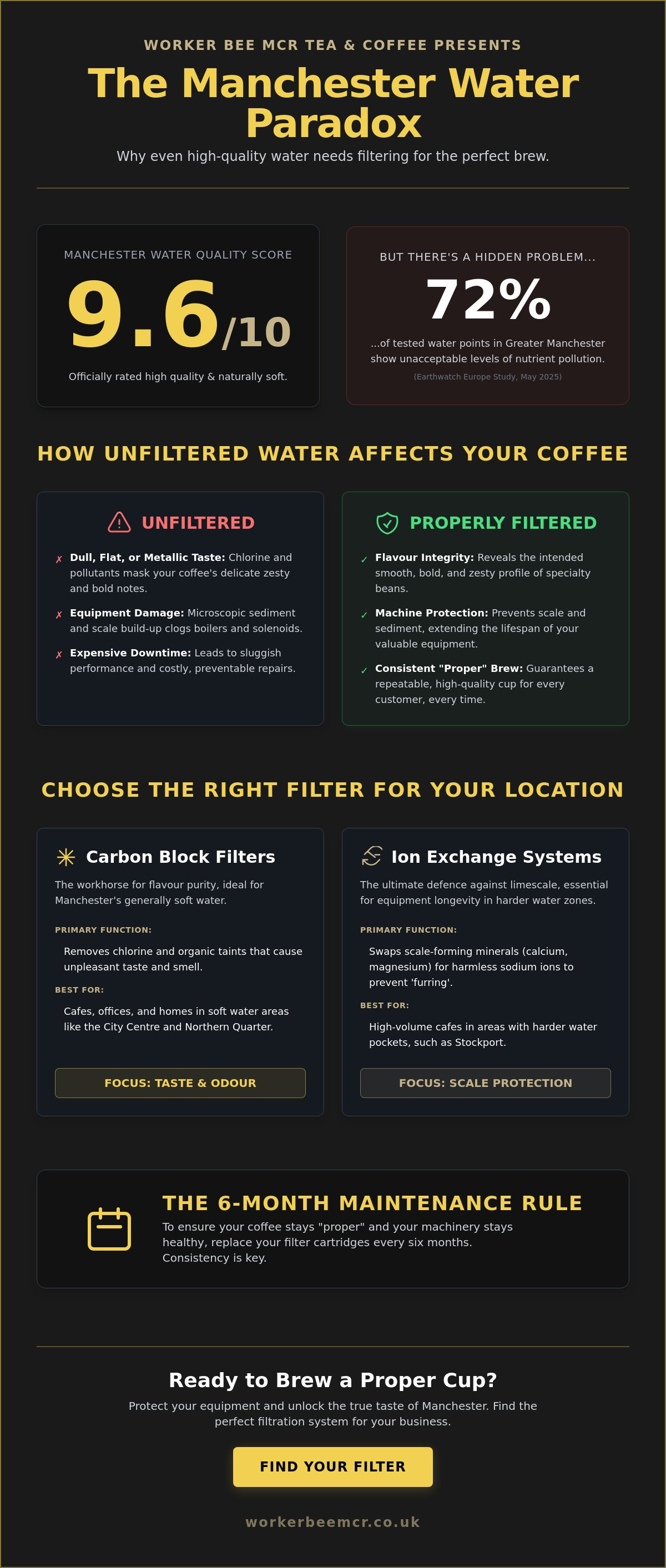
If Manchester water is officially rated a high 9.6 out of 10 for quality, why is your morning brew still hitting a flat note? You’ve invested in a top-tier commercial espresso machine and specialty beans because you care about serving a proper cup. It’s frustrating when chlorine or hidden pollutants mask the bold, zesty notes of your roast. While United Utilities confirms our water is soft, a May 2025 study by Earthwatch Europe found that 72% of tested data points in Greater Manchester showed unacceptable levels of nutrient pollution. These invisible factors don't just ruin the flavor; they threaten your machinery, making the right water filters a necessity rather than an extra.
We believe in coffee with a conscience, and that starts with protecting your equipment. In this guide, you’ll discover how to extend the lifespan of your gear and guarantee a consistent, local taste in every cup. We’re stripping away the confusion over fittings to help you secure a reliable supply from a brand born in Manchester. You'll learn exactly which filtration setup suits our unique water profile so you can get back to the buzz of a busy city with total confidence.
Key Takeaways
- Understand why even soft water needs help to reveal the smooth, bold profile of your specialty beans.
- Choose the right technology for your area, from carbon blocks to ion exchange systems for harder water spots like Stockport.
- Protect your equipment by selecting high-performance filters designed specifically for the North West’s unique water profile.
- Use our straightforward two-step guide to test your water and match it with the right commercial or domestic setup.
- Stick to the 6-month maintenance rule to ensure your coffee stays "proper" and your machinery stays healthy.
Why High-Performance Filters are Essential for Manchester’s Water Quality
Manchester is a city built on grit and industry. We take pride in what we build, what we roast, and what we pour. Many locals believe our water is the best in the UK because it’s naturally soft. While United Utilities confirms our supply from the Lake District and Peak District is indeed soft, that isn't the whole story. Soft water still carries hidden passengers that can turn a zesty specialty roast into a flat, uninspiring cup. We believe in coffee with a conscience, which means looking after your craft from the pipe to the portafilter.
Using high-quality filters is about more than just hygiene. It’s about flavor integrity. In May 2025, an Earthwatch Europe study revealed that 72% of water data points in Greater Manchester showed unacceptable nutrient pollution. These impurities, combined with the chlorine used for safety, mask the delicate notes of a Worker Bee Espresso. If your water isn't right, your coffee will taste dull or even metallic. You’re working hard to build a business; don't let invisible pollutants undermine your reputation or your equipment.
The Manchester Water Profile in 2026
Our water quality score sits at a high 9.6 out of 10, but that doesn't mean it’s ready for a commercial boiler straight from the tap. In 2026, we’ve seen more businesses in Stockport and the city centre noticing seasonal shifts in taste. During heavy rainfall, organic matter in our reservoirs increases, which often leads to higher chlorine dosing. A specialized coffee filter system acts as a crucial barrier, stripping out these chemical taints while maintaining the soft mineral balance we love. It ensures that every cup of Worker Bee Breakfast Tea or espresso tastes exactly as it should, regardless of what's happening at the reservoir.
Protecting Your Industrious Machinery
Your commercial espresso machine is the industrious heart of your cafe. It’s a significant investment that deserves a long life. Without proper filters, microscopic sediment and organic deposits build up inside your boiler and solenoids. This leads to sluggish performance and expensive downtime. While we don't handle domestic repairs, we know that for a commercial setup, proactive care is everything. Total Dissolved Solids (TDS) is the measurement of all minerals, salts, and metals dissolved in your water; in Manchester, keeping this number consistent is the secret to a repeatable, "proper" brew. By managing TDS and removing sediment, you reduce the risk of sudden mechanical failure. We’re here to help you keep the city buzzing without the stress of preventable repairs. It’s about protecting your kit so you can focus on the community you serve.
Comparing Filter Technologies: Which One Does Your Cafe Need?
Manchester's water isn't a one-size-fits-all situation. While the city centre usually enjoys soft water, areas like Stockport can lean toward the harder side. Choosing the right technology for your filters ensures you aren't just cleaning the water; you're tailoring it for the perfect extraction. It's about finding the balance between protecting your kit and letting the coffee's character shine through.
Carbon block filters are the workhorses of the city centre. They excel at stripping away chlorine and organic taints that make coffee taste like a swimming pool. However, if you're in a harder water pocket, you need ion exchange resin. This swaps out scale-forming minerals for harmless ions, protecting your boiler from the "furring" that kills machines. Many modern systems include a "bypass" setting. This allows a tiny percentage of minerals back into the mix. Coffee needs a small mineral content to pull out those bold, chocolatey notes from your beans. Without it, your brew can taste flat and hollow.
Carbon vs. Scale Protection
For a small office in the Northern Quarter, a simple carbon filter usually does the trick. It keeps the water fresh and the taste clean for your team. But for a high-volume cafe, you need more grit. Scale inhibitors don't remove minerals; they just stop them from sticking. True softeners or ion exchange systems are better for busy machines. This protection is vital for the Worker Bee Espresso profile. Without it, the acidity of the roast can clash with mineral buildup, leaving you with a cup that's bitter instead of zesty. If you're unsure which kit fits your counter, you can browse our local coffee solutions to see what we recommend for the North West.
Choosing the Right Capacity
Getting the size right is a balancing act. If you buy a filter that's too small, you'll be swapping it out every few weeks. If it’s too big, the water might sit stagnant during quiet periods. Calculate your daily litre usage by tracking your shots and tea pours. Most commercial filters come with a rated capacity, often between 2,000 and 10,000 litres. We recommend using a digital flow meter. It’s a small device that counts every drop, taking the guesswork out of maintenance. It tells you exactly when the cartridge has reached its limit, so you never serve a sub-par brew. Matching the size to your machine’s flow rate prevents pressure drops, keeping your extractions consistent during the morning rush.
The Worker Bee Guide to Selecting Filters for Your Business
Choosing the right gear isn't just about the price tag. It’s about matching your filtration to the specific rhythm of your day. Whether you’re running a bustling spot in the city centre or brewing for the team in a quiet office, the selection process remains the same. We’ve broken it down into four industrious steps to ensure your coffee stays "proper" and your machinery stays healthy. It’s about doing things the right way, with a bit of local pride and professional grit.
- Step 1: Test your local water. Don't guess. Use a Manchester-specific test kit. While United Utilities provides a high-quality supply, local pipework in older buildings can introduce sediment or metallic taints.
- Step 2: Identify your equipment. A domestic setup has vastly different pressure requirements than a multi-group head machine. Your filters must match the intended flow rate of your kit.
- Step 3: Determine your peak volume. A Saturday morning rush in Didsbury requires a higher litre capacity than a steady office environment. Overloading a small filter leads to "channelling," where water bypasses the filtration media entirely.
- Step 4: Select your micron rating. This refers to the size of particles the filter can catch. For Manchester’s soft water, a 5-micron carbon block is often the sweet spot, balancing flow speed with effective impurity removal.
Filters for the Busy Manchester Cafe
If you're operating in Ancoats or the Northern Quarter, you know the morning rush is no joke. High-flow requirements for multi-group commercial coffee machines mean your filtration system can't afford to drop the pressure. We recommend systems with quick-change cartridges. These allow your baristas to swap out a spent unit in seconds without needing a toolbox. This keeps the queue moving and ensures every espresso pulled during the peak hour maintains its bold, zesty profile. Reliability is the backbone of any successful local business.
Domestic Filters for Home Enthusiasts
You don't need a commercial shop to enjoy world-class coffee. Many home enthusiasts are upgrading their setups to match the quality of the best coffee shops in the city. While jug-based filters are a decent start, they often struggle with the chlorine levels found in some Greater Manchester postcodes. An inline filter, fitted directly to your cold water tap or machine feed, is a superior investment. It provides a constant supply of purified water, making your morning Worker Bee Filter coffee taste cleaner and more vibrant. Simple maintenance, like a quick swap every six months, keeps your home brewery running like a pro setup.
Standalone Solutions: Standout Products from the Worker Bee Collection
Choosing the right hardware is the final step in securing your city-centre brew. Our 2026 collection features five key products specifically curated for the North West’s water profile. We’ve tested these systems in the busiest kitchens and the smallest mobile vans to ensure they stand up to the grit of Manchester’s daily grind. It isn't just about selling a part; it’s about providing a solution that keeps your industrious heart beating without a hitch. Every product we stock aligns with our "Coffee with a Conscience" promise, offering sustainable recycling options to keep our community green.
For independent cafes and mobile coffee vans in spots like Ancoats, space is often at a premium. We offer compact, high-performance filters that deliver commercial-grade purity without taking up half your under-counter storage. These units are built to handle high-pressure environments, ensuring your flow rate never falters when the queue starts stretching out the door. We believe in quality that works as hard as you do.
The Best All-Rounder for MCR Hospitality
Our flagship all-rounder is a high-capacity cartridge designed to balance minerals while aggressively removing chlorine taints. This model has become a firm favourite for Stockport’s busiest venues because it handles the slightly higher mineral content found in that area with ease. It features a multi-stage filtration process that protects your boiler from sediment while leaving just enough mineral content for a proper extraction. Most venues find these cartridges last for approximately 6,000 litres, or six months of heavy use, providing a reliable shield for your commercial machinery. It’s a straightforward, hardworking piece of kit that does exactly what it says on the tin.
Specialist Filters for High-End Espresso
If you’re running premium machinery like a La Marzocco, you need precision. Specialist filters in our collection focus on protecting these sensitive internal components while preserving the bold and smooth notes of our Worker Bee roasts. These systems use advanced ion-exchange technology to prevent even the smallest hint of scale buildup in your precision boilers. While the initial investment is higher than a standard carbon block, the return on investment is clear. You’ll see a 40% reduction in descaling requirements and significantly fewer solenoid failures over the machine's lifespan. This level of protection ensures your "proper" brew remains consistent from the first cup to the last. To find the perfect match for your setup, you can view our full range of commercial filtration products today.
Installation and Maintenance: Keeping Your Manchester Brew Consistent
Manchester’s industrious spirit means doing things right the first time. You’ve picked the perfect kit; now you need to keep it running. Maintaining your filters isn't a chore; it’s a commitment to your customers and your craft. You'll know the water is winning when that crisp, clean Manchester taste starts to fade. If you notice a faint chemical smell or if your espresso shots are pulling slower than usual, your filter is likely exhausted. These small signs are your machine's way of asking for a refresh before the grit of daily service takes its toll.
The 6-month rule is the gold standard for North West hospitality. Even if you haven't reached the rated litre capacity, the carbon media inside the cartridge degrades over time. Stagnant organic matter can lead to bacterial growth, especially during warmer months when reservoir temperatures rise. Swapping your filter twice a year ensures your Worker Bee Breakfast Tea stays bright and your espresso remains zesty. Most modern systems use a simple twist-and-lock mechanism. You don't need to call out a plumber; just shut off the water valve, vent the pressure, and swap the cartridge. It’s a five-minute job that saves hundreds in potential equipment damage and keeps the city buzzing.
Troubleshooting Common Filter Issues
Airlocks are the most common headache after a change. If your pressure drops to zero, simply disconnect the outlet hose and run the water into a bucket until the flow is steady. You should also check your bypass setting. If it’s set too high, you’ll get scale; too low, and your coffee will taste flat. You must flush at least 10 litres of water through a new carbon filter to remove fine dust before connecting it to your machine. This prevents "carbon fines" from clogging your delicate espresso machine valves and ensures the first cup you serve is perfect.
Sustainable Disposal in Greater Manchester
We believe in coffee with a conscience. In May 2025, Earthwatch reported that nutrient pollution is a major concern for our local waterways, with 72% of tested data points showing unacceptable levels. We don't want spent plastic cartridges adding to the problem. Many local recycling initiatives in Greater Manchester now accept commercial filters and cartridges for proper processing. By choosing a sustainable path, you're helping keep our city green while serving a proper brew. If you’re ready to refresh your setup and protect your gear, you can browse our full range of filters today and join our community of quality-focused brewers.
Secure Your Proper Brew with Local Expertise
Your coffee machine is the industrious heart of your business; it deserves protection that matches its hard work. We’ve explored how the right filtration setup defends against the 72% of local water points that showed unacceptable nutrient levels in May 2025. By choosing the correct technology for your specific Manchester postcode, you ensure that every cup of Worker Bee Espresso hits those bold, zesty notes your customers love. We’re proud to be Manchester-born and bred, offering professional expertise that’s rooted in our community’s heritage.
Reliability comes from proactive care and using high-quality equipment built for the North West’s unique profile. We’re trusted by Greater Manchester’s finest independent cafes to provide sustainable solutions that align with our coffee with a conscience philosophy. Don't wait for a mechanical failure or a flat-tasting brew to take action. Invest in your equipment’s longevity and your brand’s consistency today. Shop our curated range of high-performance filters to keep your machinery healthy and your coffee tasting proper. Let’s keep this city buzzing together.
Frequently Asked Questions
Do I really need water filters for my coffee machine in Manchester?
Yes, because tap water quality doesn't account for what happens in the local pipework of our older city buildings. While United Utilities provides a high-quality supply, a filter ensures that chlorine and sediment don't reach your cup. This protection is vital for maintaining the industrious heart of your business and ensuring every pour is perfect.
How often should I change the filters in my commercial espresso machine?
You should replace your cartridge every six months or once you reach its rated litre capacity. Time is just as important as volume because the internal carbon media degrades and can lose its effectiveness. Keeping to this schedule ensures the city's morning brew stays consistent and your machinery stays healthy.
What happens if I don’t use a filter in my Stockport cafe?
You’ll likely face rapid scale buildup and potential machine failure because Stockport often has slightly higher mineral levels than the city centre. Untreated minerals "fur" up boilers and block delicate solenoids, leading to expensive downtime. Using the right protection prevents these mechanical headaches and keeps your business buzzing.
Can I use a standard domestic water filter for my professional coffee machine?
No, domestic units cannot handle the high pressure and rapid flow rates required by commercial gear. Using a domestic unit will cause significant pressure drops and poor extraction during busy periods. You need commercial grade filters to ensure your espresso machine performs reliably during the Didsbury weekend rush.
How much do commercial coffee machine filters cost in 2026?
Pricing for commercial filtration depends entirely on your daily litre usage and the specific mineral profile of your postcode. While we don't list set costs here, investing in a high-quality system typically pays for itself by preventing a 40% increase in descaling expenses. Contact a local expert for a quote tailored to your specific Manchester venue.
Will a water filter improve the taste of my Worker Bee Espresso?
Absolutely, it removes the chemical taints and chlorine that mask the coffee's natural profile. By stripping out these impurities, the filter reveals the bold and zesty notes of our specialty roasts. It transforms a standard cup into a proper Manchester brew that your customers will remember.
Can I install these filters myself or do I need a Manchester plumber?
Most modern commercial systems feature a simple twist-and-lock design that your cafe staff can handle without professional help. You just need to shut off the water, vent the pressure, and swap the cartridge. This user-friendly setup means you don't have to pay for a city-centre call-out fee every time you need a refresh.
Are there eco-friendly recycling options for coffee filters in the North West?
Several Greater Manchester recycling schemes now accept commercial filters to prevent plastic waste from hitting local landfills. We actively support these initiatives as part of our "Coffee with a conscience" mission. It’s a simple way for your cafe to contribute to a greener North West while serving a top-quality product.