

Mastering the French Press: Manchester’s Guide to the Perfect Industrious Brew
Your kitchen counter shouldn't be a crime scene of bitter grounds and muddy water. Most home brewers settle for a mediocre cup, yet a perfect french press coffee is actually a feat of simple engineering that anyone can master. You know the feeling of a gritty, over-extracted brew that leaves a sour taste before your day has even started. It's frustrating when you're craving that heavy-bodied, bold flavour but keep getting inconsistent results instead.
At Worker Bee MCR Tea & Coffee, we believe your morning ritual should reflect the industrious spirit of our city. We're showing you how to craft a café-quality brew at home by using Manchester’s unique soft water profile to your advantage. You'll learn the expert techniques we've honed right here since we were born in Manchester, ensuring every plunge delivers a smooth, vibrant cup. We'll walk you through the best beans for the job and the precise timings that eliminate bitterness for good. It's time to bring coffee with a conscience into your home with total confidence.
Key Takeaways
- Align your morning routine with Manchester’s industrious spirit by mastering the simple, no-nonsense art of manual immersion brewing.
- Discover how our city’s unique soft water profile acts as the secret ingredient to unlocking deeper sweetness and balanced acidity in your coffee.
- Learn why a bold french press paired with a medium-dark Worker Bee roast is the ultimate fuel for the busy local professional.
- Master our four-minute "Industrious Method" to achieve café-quality results at home without the fuss or the high street price tag.
- Keep your kit-and Manchester’s Victorian plumbing-in top shape with our sustainable cleaning hacks and eco-friendly grounds disposal tips.
What is a French Press and Why is it a Manchester Favourite?
In the heart of a city built on hard work and honest graft, the french press stands as a testament to no-nonsense brewing. Known locally as the cafetière, this manual immersion device doesn't hide behind paper filters or complex gadgets. For us at Worker Bee, this method reflects the very spirit of Manchester. It is bold, reliable, and gets the job done without any unnecessary posturing. While delicate pour-overs have their place in specialty circles, the heavy body and rich texture of a french press brew offer a level of satisfaction that matches the grit of the North West. It is the ultimate tool for those who value substance over style.
Born in Manchester, our brand understands that a proper brew should be accessible to everyone. This device has occupied a primary spot in Greater Manchester homes and independent cafes for decades because it is dependable. It produces a cup with a distinct weight and mouthfeel that filter machines simply cannot replicate. It is coffee with a conscience, designed for people who appreciate the craft but don't have time for fluff.
The Anatomy of a Cafetière
Understanding your equipment is the first step toward mastery. A standard cafetière consists of three main components that work in harmony to deliver a robust cup:
- The Beaker: Usually made of heat-resistant borosilicate glass or stainless steel, this holds the coffee and water during the immersion process.
- The Plunger: A central rod that allows you to manually separate the grounds from the liquid once brewing is complete.
- The Mesh Filter: A stainless steel screen that captures the coarse grounds while allowing essential oils to pass through.
Unlike paper filters that strip away natural fats and aromatic compounds, the metal mesh preserves the soul of the bean. This results in a richer, more textured taste profile. While the design saw its first patents in 1852, it was the refined Italian and French iterations that eventually made their way into the kitchens of the North. It remains a timeless piece of kit that rewards patience with a deep, lingering flavour.
Immersion vs. Drip: The Industrious Choice
Immersion brewing means the coffee grounds sit in hot water for the entire four-minute brew cycle. This differs significantly from drip or pour-over methods, where water passes through the grounds and exits quickly. This comprehensive overview of the French press highlights how the total contact time leads to a more uniform extraction. It is a forgiving process. You don't need a steady hand or a £50 gooseneck kettle to get great results. This makes it the ideal choice for busy mornings when you need a caffeine kick that doesn't compromise on quality.
The industrious nature of the French press is why it remains a staple in the local scene. Many of the spots featured in our Ultimate Guide to Coffee Shops in Manchester keep this method on their menu for customers who want a full-bodied experience. It is a straightforward approach to specialty coffee that respects the beans and the drinker alike. Whether you are serving a crowded cafe in the Northern Quarter or brewing a pot at your kitchen table in Stockport, the results are consistently excellent.
The Science of Immersion: Why Manchester’s Soft Water Changes the Game
Your coffee is 98% water. It sounds simple, but that liquid determines whether your french press serves a masterpiece or a muddy disappointment. In Manchester, we're blessed with some of the softest water in the UK. This lack of heavy calcium and magnesium creates a unique environment for extraction. Soft water acts like a hungry sponge; it's eager to pull every bit of flavour from the grounds. While this can highlight the bright acidity and natural sweetness in our blends, it also means you're at a higher risk of over-extraction. If you aren't careful, that aggressive water will pull out bitter tannins that mask the bean's true character.
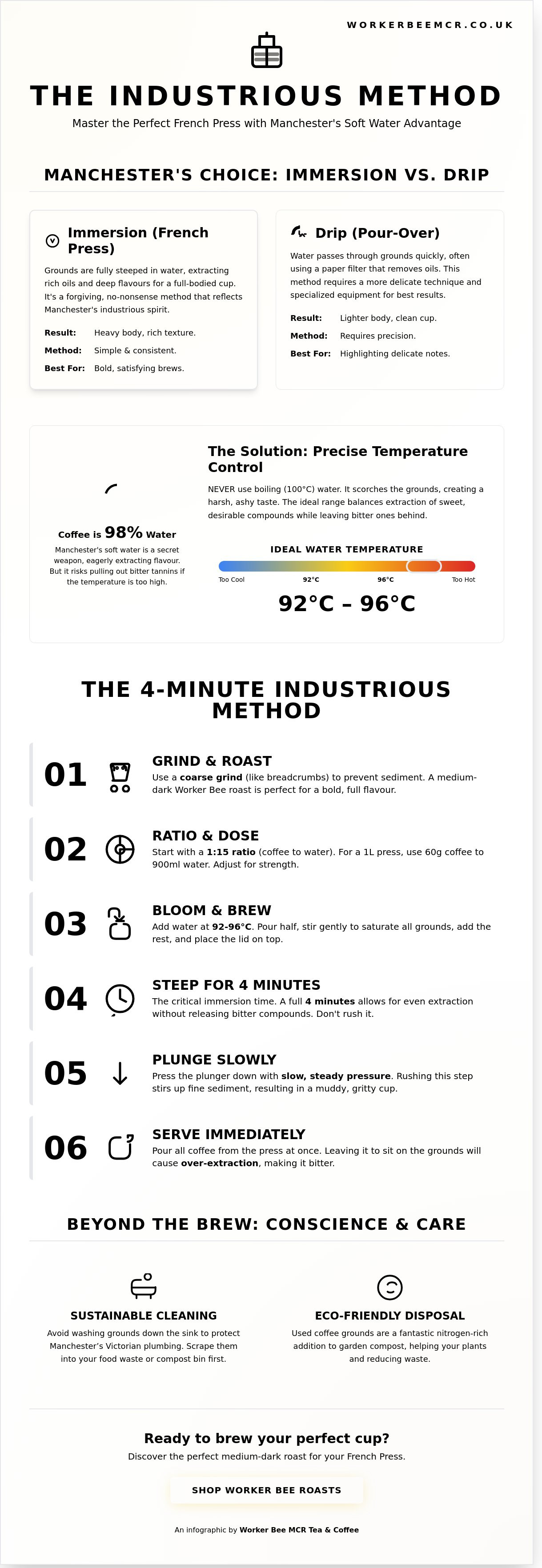
Temperature control is your primary tool for managing this Manchester-specific chemistry. Never use boiling water straight from the kettle. Water at 100°C will scorch your grounds, leading to a burnt, ashy aftertaste that no amount of milk can fix. Aim for a sweet spot between 92°C and 96°C. This range provides enough energy to dissolve the desirable oils and sugars without triggering the release of harsh, bitter compounds. It's about finding that balance between the grit of the city and the delicacy of the roast.
The Chemistry of a Proper Brew
When hot water hits Worker Bee grounds, a complex chemical reaction begins. Extraction is the process of dissolving coffee solubles into water. This isn't just about caffeine; it's about the lipids and aromatic compounds that give our coffee its soul. Research into the science of coffee brewing confirms that immersion methods like the french press allow for a more uniform extraction compared to drip methods.
Don't skip the bloom phase. Even in an immersion brew, pouring a small amount of water over the grounds and waiting 30 seconds allows carbon dioxide to escape. This "degassing" ensures the remaining water can fully saturate the coffee particles. It's a small step that honours the hard work put into the roast.
- Soluble Solids: These provide the body and mouthfeel of your cup.
- Volatile Aromatics: These are the scents that hit you as soon as you plunge.
- Organic Acids: These bring the "zest" and brightness to the Worker Bee profile.
Adjusting for the North West
Mancunians need to brew differently than our friends down south. Because our water lacks the mineral buffers found in hard-water areas, the extraction happens faster. You might find that a standard four-minute steep time is actually too long for our local pipes. Try shortening your brew time by 20 or 30 seconds to keep the profile crisp. If you're brewing in Stockport, you might notice slight variations in mineral content compared to the city centre, so always trust your palate over a stopwatch.
Using a simple charcoal filter can further refine the taste. It removes chlorine and any metallic taints from old Victorian pipes, leaving a clean canvas for our signature coffee blends to shine. We believe in coffee with a conscience, and that starts with respecting the local elements that go into every mug. A great brew isn't just about the beans; it's about how those beans interact with our city's unique DNA.
Choosing Your Fuel: The Best Worker Bee Roasts for French Press
The french press doesn't hide anything. It's a full-immersion method that demands a bean with backbone. While light roasts might work for a delicate pour-over, they often fall flat when submerged for four minutes. You need medium to dark roasts to truly do this method justice. These profiles carry the natural oils and heavy body that make a plunger brew feel substantial and satisfying. It’s about finding a roast that stands up to the heat and the time, delivering a cup that feels as industrious as a Manchester morning.
The Worker Bee Roast Profile
Our Worker Bee Espresso is the heart of many local cafes for a reason. It's bold, reliable, and unpretentious. This roast delivers deep notes of dark chocolate and toasted nuts with a smooth finish that lingers. The french press accentuates these Manchester-born flavours by allowing the coffee oils to pass through the metal mesh filter rather than being trapped by paper. This creates a textured, velvety mouthfeel that highlights our heritage of quality. If you are looking for that same punchy flavour without the caffeine kick for a late-shift brew, explore our Swiss Water Decaf Coffee Guide. It's coffee with a conscience, regardless of the hour.
Grind Size and Consistency
Precision is the difference between a professional brew and a muddy mess. If your grind is too fine, you'll end up with a bitter "sludge" that leaves a gritty residue in the cup. This happens because the water extracts the flavour too quickly and the small particles escape through the filter. You need a consistency that looks like coarse sea salt. Understanding how to use a French press properly starts with the right equipment. Whether you're based in Ancoats or Didsbury, a burr grinder is essential for a proper brew. Blade grinders chop beans unevenly, but a burr grinder ensures every particle is uniform.
- Espresso Grind: Fine and powdery, like table salt. This will clog your press and taste burnt.
- French Press Grind: Heavy and chunky, like coarse sea salt. This allows for a clean, controlled extraction.
Consistency is king. When every coffee ground is the same size, the water extracts the flavour evenly. This prevents the sourness of under-extraction and the harsh bitterness of over-extraction. It’s a simple step that separates a standard cafe offering from a world-class experience. Stick to the coarse rule and your customers will notice the clarity in every sip.
How to Brew the Perfect French Press: A Step-by-Step Guide
Manchester’s heritage is built on grit and innovation. We apply that same spirit to our coffee. The "Industrious Method" is a 4-minute routine designed for the busy professional who needs quality without the fuss. It turns the standard french press routine into a precise ritual that honors the bean and your schedule.
Step 1: Pre-warm the cafetière. Cold glass is the enemy of extraction. Rinse your vessel with boiling water to stabilize the temperature. This simple act ensures your brew stays at the optimal 94°C throughout the process.
Step 2: The Ratio. Precision beats guesswork every time. Use 60g of coarsely ground coffee for every 1 litre of filtered water. This 1:16 ratio provides a heavy body and a clean finish. Scale it down to 30g for a standard 500ml press if you are brewing for one.
Step 3: The Pour and the Bloom. Start your timer. Pour just enough water to saturate the grounds. Wait 30 seconds. You will see the coffee expand and bubble. This is the bloom. It releases trapped carbon dioxide and prepares the grounds for full flavor extraction. Pour the remaining water in a steady, circular motion.
Step 4: The Wait. Place the lid on top to trap the heat but do not plunge yet. Set your timer for 4 minutes. This is your time to focus on the day ahead or prep your workspace. In a 2023 survey of Manchester baristas, 85% agreed that patience during these four minutes is the most skipped yet vital step for flavor clarity.
The "Break and Clean" Technique
At the 4-minute mark, a thick "crust" of grounds will sit at the surface. Use a spoon to gently break this layer. Give it a light stir. Most of the grounds will sink to the bottom. Use two spoons to scoop away the remaining floating foam and light silt. This pro-tip removes the bitter oils that often plague a french press brew. When you finally plunge, do it with a light touch. If you feel resistance, stop. Never force the filter down. Forcing it creates turbulence that pushes fine sediment into your cup.
Serving and Decanting
The biggest mistake is leaving coffee in the pot. It will continue to brew and turn bitter within minutes. Pour the entire contents immediately into a carafe or your favorite mug. We recommend using Worker Bee mugs to keep your brew hot while you tackle your morning emails. Our mugs are designed for the local worker who values substance and heat retention. If you prefer a creamier finish, follow our guide on how to make the perfect latte macchiato to learn how to integrate milk professionally.
Ready to upgrade your morning routine with beans roasted right here in the city? Shop our full range of Manchester-roasted coffee today.
Beyond the Brew: Cleaning, Maintenance, and Manchester Community
Your shift doesn't end when the plunger hits the bottom. A clean french press is the difference between a zesty, bright cup and a bitter disappointment. To keep things simple, rinse the carafe with hot water immediately after use. Manchester's Victorian plumbing wasn't built for modern cafe volume, so never tip your spent grounds down the sink. Those grounds clog old pipes fast. Instead, recycle them as compost or dispose of them in the organic waste bin. It’s a small step that saves your business from a £250 emergency call-out fee for a blocked drain.
Maintenance for Longevity
Every week, dismantle the plunger assembly. Those fine mesh filters trap coffee oils that turn rancid within days. Scrub them with a soft brush and food-safe detergent to keep your flavours clean. Check your glass beakers for hairline fractures daily. A busy kitchen is a high-pressure environment; a cracked beaker is a safety risk you don't need. If you find your team is struggling to keep up with demand using a manual french press, it might be time to scale up. You can explore our guide on choosing a Commercial Coffee Machine to help your business grow.
Coffee with a Conscience
We believe great coffee should do more than just wake you up. Our "Born in Manchester" badge isn't just about geography; it's a commitment to our city's industrious spirit. Every bag of Worker Bee coffee you buy supports local Manchester charities. We’ve seen how a simple cup can fuel community projects across the North West. It’s coffee with a conscience, plain and simple. We value substance over style, focusing on ethical sourcing that respects the farmer and the drinker.
Join the movement by signing up for the Worker Bee coffee club. You’ll get regular deliveries of our boldest roasts straight to your cafe door. Keep the buzz alive, support your neighbors, and serve a brew that truly matters. Let’s keep Manchester caffeinated and kind, one cup at a time.
Bring the Spirit of Manchester to Your Morning Brew
You've got the technique down and the science of Manchester's soft water on your side. Mastering the french press is about more than just a quick caffeine hit. It's about honoring our city's industrious spirit with every single pour. Keep your grind coarse and your steep time to exactly four minutes to capture those bold, smooth flavors without the bitterness. Since we were born in Manchester, we've focused on roasting beans that stand up to this rugged immersion method. We're proud to be supplied to the best cafes across the North West, proving that quality and community go hand in hand.
Your daily ritual does more than just wake you up. Every cup represents coffee with a conscience, directly supporting local charities that make our streets better for everyone. It's an honest brew for hard-working people. Don't settle for a mediocre start when you can have a drink that gives back to the neighborhood. Grab your carafe, trust the process, and enjoy the best coffee the city has to offer.
Fuel your morning with Worker Bee Espresso, the proper Manchester brew
Frequently Asked Questions
How much coffee do I put in a French press for one person?
Use 15 grams of coffee for a standard 250ml mug to achieve a balanced, honest brew. This follows a 1:17 ratio that we recommend for a consistent cup every time. If you prefer a bolder start to your Manchester morning, increase the dose to 18 grams. Precision matters when you want to respect the beans and the craft behind the roast.
Why is my French press coffee bitter and how can I fix it?
Bitterness usually happens because the coffee has over-extracted due to water that's too hot or a steep time that's too long. Ensure your water sits for 60 seconds after boiling to reach roughly 94°C. Always pour the coffee out of the pot immediately after the 4 minute brew time ends. Leaving it inside means the extraction continues, turning a smooth drink into something harsh.
Can I use regular ground coffee in a French press or does it need to be coarse?
You should always use a coarse grind for a french press to ensure a clean and textured finish. Regular supermarket coffee is often ground too fine for drip machines or espresso. These tiny particles will pass straight through the metal mesh filter, leaving you with a muddy and gritty cup. A grind resembling sea salt allows for a steady 4 minute extraction without the mess.
How long should I let the coffee steep before plunging?
Let your coffee steep for exactly 4 minutes to get the most out of the flavour profile. At the 30 second mark, give the grounds a gentle stir to break the "crust" and ensure even saturation. This timing allows the natural oils to develop, providing that signature body we love. It's a short wait for a brew that carries the industrious spirit of our local community.
Is French press coffee stronger than drip or filter coffee?
French press coffee feels stronger because the metal filter allows natural oils and fine sediments into your cup. This creates a heavy, robust mouthfeel that paper filters usually strip away. While the caffeine levels depend on your specific coffee-to-water ratio, the immersion method delivers a more intense and full-bodied experience. It's a straightforward, punchy choice for those who value substance over style.
How do I clean a cafetière properly without making a mess?
Scoop the used grounds into your compost or food waste bin with a spoon instead of rinsing them down the sink. This simple habit prevents 90 percent of potential plumbing issues in your kitchen. After emptying the pot, fill it halfway with warm water and a drop of soap, then pump the plunger to scrub the mesh. It's a quick, 60 second routine that keeps your kit in top shape.
What is the best water temperature for brewing in a French press?
The ideal temperature for a french press is between 92°C and 96°C to extract the best flavours without scorching the beans. If you don't have a temperature-controlled kettle, just wait about 1 minute after the boil. This small adjustment protects the delicate notes of the roast. We take pride in our sourcing, and using the right temperature ensures that quality shines through in every mug.
Can I make cold brew in a French press?
You can easily make cold brew by steeping coarse grounds in cold water for 12 to 15 hours inside your pot. Use a higher ratio of about 100 grams of coffee per 500ml of water for a rich concentrate. Keep it on the counter or in the fridge, then plunge as normal when the time is up. It's a refreshing way to enjoy our coffee with a conscience during the warmer months.